10,000 search results (0.017 seconds)
  1. funk - Unknown license
  2. Broken Toys - Unknown license
  3. Bifurk - Unknown license
  4. Hullunkruunu - Unknown license
  5. moebius - 100% free
  6. Iron Maiden - Unknown license
  7. Aerosol - Unknown license
  8. Tenby Five - Unknown license
  9. Nu School Munitions - Unknown license
  10. Weekend Warrior - 100% free
  11. Captain Kidd Demo - Unknown license
  12. Bandwidth Bandless BRK - Unknown license
  13. Metalic Avacodo - Unknown license
  14. Ishirkian - Personal use only
  15. GauFontLoveRocket - Unknown license
  16. Independence - Unknown license
  17. URAL 3d - Unknown license
  18. OhMyGodStars - Unknown license
  19. Sylar Stencil - Unknown license
  20. Occoluchi Minicaps - Personal use only
  21. Zig Zag ML - Personal use only
  22. Ganz Egal - Personal use only
  23. BN Manson Nights - Unknown license
  24. Monster Paparazzi - Unknown license
  25. Chizz Wide High - Unknown license
  26. Effloresce - Unknown license
  27. Pilsen Plakat - Unknown license
  28. MicroMieps - Unknown license
  29. Mechanical Fun - Unknown license
  30. HVD Poster - Unknown license
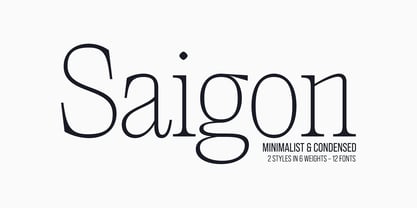
  31. Saigon by The Paper Town, $25.00
    Saigon is a minimalist condensed serif family. With clean lines and tight curves, its personality dwells in its simplicity making it a timeless editorial typeface. As the italic breaks with the traditional strokes and embrace a more modest yet modern look, it blends in nicely with its upright sister, thus creating an harmonious rhythm which emphasis the minimalist approach of Saigon. The low contrast serif is created to look great in both display and text. Whether it’s bold headlines of descriptive paragraphs, Saigon aims to be as versatile and functional as possible. It supplies 6 weights from thin to bold allowing you to elevate your typography designs in a minute while keeping it simple. Cause great design should be simple. The type family supports major Latin-based languages along with opentype features such as fractions, old style numerals, ligatures, case sensitive punctuation, stylistic alternates symbols and more.
  32. Annlie by ITC, $29.99
    Annlie™ Extra Bold and Annlie Extra Bold Italic are two display faces designed by Fred Lambert in 1966 for the Annlie type family. These two samples from the Annlie family are both fat faces. Fat faces were offshoots of the modern, or Didone, typefaces that were de rigueur during the early 1800s. These fat faces were among the first typefaces to be used solely for advertising purposes. Naturally, they were always used in larger point sizes, in display functions. Annlie could be called an optimization of these old advertising typefaces. With high x-heights, ultra contrast between thick and thin strokes, and perfectly engineered drawing techniques, Annlie is a highly crafted typeface. Give it a spin in your next advertising campaign! Annlie’s fine thin strokes are very graceful in their appearance, and lend a strong, yet soft, feminine feeling to anything they touch.
  33. Albertina by Monotype, $29.99
    Albertina was a typeface ahead of its time. It was in the early 1960s when designer Chris Brand, an accomplished calligrapher, aspired to draw a typeface based on the principles of calligraphy. Unfortunately, typesetting machines of that era put many restrictions on designers. Characters had to be drawn within a very coarse grid, which also defined their spacing. Technological limitations meant that italic designs often had to share the same character widths as the romans. Designers were forced to draw italic faces much wider and with more open spacing than what would be typical in calligraphic lettering or hand-set type. Not surprisingly, production of the first Albertina fonts went very slowly. Brand would submit his character drawings, and the Monotype Drawing Office would modify them to be compatible with the company's typesetting equipment. The new drawings would then be sent back to Brand for approval or rework. Most were reworked. The process took so long, in fact, that by the time the face was completed it was once again out of phase with the times: instead of being released as metal type for the Monotype composing machines it had been tailored for, Albertina debuted as phototype fonts for the Monophoto typesetter. The design's first use was for a catalog of the work of Stanley Morison, exhibited at the Albertina Library in Brussels in 1966. Sales of the design were not remarkable. With the advent of digital type technology, Albertina's story took a far happier turn. Frank E. Blokland, of the Dutch Type Library, used Brand's original, uncompromised drawings as the foundation of a digital revival. The Monophoto version had taken a considerable battering from the limitations of Monotype's unit system," recalls Blokland, "but there was no need for me to incorporate these restrictions in the digital version." With the full backing of Monotype and original designer Brand looking over Blokland's shoulder, a new design for Albertina emerged, displaying all the grace and verve of Brand's original drawings. The basic family drawn by Brand also grew into three weights, each with an italic complement and a suite of small caps and old style figures."
  34. Sansumi - Unknown license
  35. Earth's Mightiest 3D - Unknown license
  36. SF Quartzite - Unknown license
  37. SF Juggernaut - Unknown license
  38. Minya Nouvelle - Unknown license
  39. SF Technodelight - Unknown license
Looking for more fonts? Check out our New, Sans, Script, Handwriting fonts or Categories
abstract fontscontact usprivacy policyweb font generator
Processing