10,000 search results (1.389 seconds)
  1. Tinet - Unknown license
  2. beestings - Unknown license
  3. Big - Unknown license
  4. Brain Stew - Unknown license
  5. Goombella - Unknown license
  6. Shards - Unknown license
  7. Xeroprint - Unknown license
  8. Ruinik - Unknown license
  9. Illustrator - Unknown license
  10. Bearpaw - Unknown license
  11. Brushcut - Unknown license
  12. Bolide - Unknown license
  13. GoodDog - Unknown license
  14. Pincel 2 Plain - Unknown license
  15. Scrawn AOE - Unknown license
  16. crappyJoe - Unknown license
  17. Ygnorant - Unknown license
  18. Fh_Faith - Personal use only
  19. dUBBEL - Unknown license
  20. Foot Fight - Unknown license
  21. D_rough - Unknown license
  22. tulisan tanganku - Unknown license
  23. Gort's Fair Hand Upright - Unknown license
  24. vtks animal 2 - 100% free
  25. Brubeck AH - Unknown license
  26. Morevibe - Personal Use - Personal use only
  27. KG What A Time - Personal use only
  28. KG The Last Time - Personal use only
  29. KG How Many Times - Personal use only
  30. Star Time Too JL - Unknown license
  31. KR Christmas Time 2 - Unknown license
  32. Once upon a time - Unknown license
  33. Question of time [simple] - Unknown license
  34. KR Lotsa Time Dings - Unknown license
  35. KR Party Time Dings - Unknown license
  36. Fun Time Nouveau JNL by Jeff Levine, $29.00
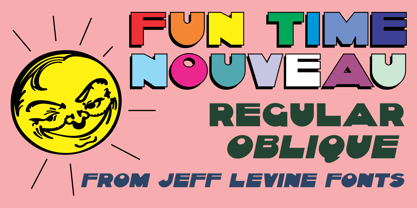
    “One Hundred Alphabets for the Show Card Writer” was published in 1919 to afford sign artists the ability to create signs and show cards in then-contemporary lettering styles. One such alphabet was big, bold and representative of the Art Nouveau stylings popular in the early part of the 20th Century. Most likely it was applied to store sales and public events that were casual and informal, for its letter forms are free of any constraints. This design is now available as Fun Time Nouveau JNL in both regular and oblique versions.
  37. Times New Roman Seven by Monotype, $67.99
    In 1931, The Times of London commissioned a new text type design from Stanley Morison and the Monotype Corporation, after Morison had written an article criticizing The Times for being badly printed and typographically behind the times. The new design was supervised by Stanley Morison and drawn by Victor Lardent, an artist from the advertising department of The Times. Morison used an older typeface, Plantin, as the basis for his design, but made revisions for legibility and economy of space (always important concerns for newspapers). As the old type used by the newspaper had been called Times Old Roman," Morison's revision became "Times New Roman." The Times of London debuted the new typeface in October 1932, and after one year the design was released for commercial sale. The Linotype version, called simply "Times," was optimized for line-casting technology, though the differences in the basic design are subtle. The typeface was very successful for the Times of London, which used a higher grade of newsprint than most newspapers. The better, whiter paper enhanced the new typeface's high degree of contrast and sharp serifs, and created a sparkling, modern look. In 1972, Walter Tracy designed Times Europa for The Times of London. This was a sturdier version, and it was needed to hold up to the newest demands of newspaper printing: faster presses and cheaper paper. In the United States, the Times font family has enjoyed popularity as a magazine and book type since the 1940s. Times continues to be very popular around the world because of its versatility and readability. And because it is a standard font on most computers and digital printers, it has become universally familiar as the office workhorse. Times?, Times? Europa, and Times New Roman? are sure bets for proposals, annual reports, office correspondence, magazines, and newspapers. Linotype offers many versions of this font: Times? is the universal version of Times, used formerly as the matrices for the Linotype hot metal line-casting machines. The basic four weights of roman, italic, bold and bold italic are standard fonts on most printers. There are also small caps, Old style Figures, phonetic characters, and Central European characters. Times? Ten is the version specially designed for smaller text (12 point and below); its characters are wider and the hairlines are a little stronger. Times Ten has many weights for Latin typography, as well as several weights for Central European, Cyrillic, and Greek typesetting. Times? Eighteen is the headline version, ideal for point sizes of 18 and larger. The characters are subtly condensed and the hairlines are finer."
  38. KG The Last Time by Kimberly Geswein, $5.00
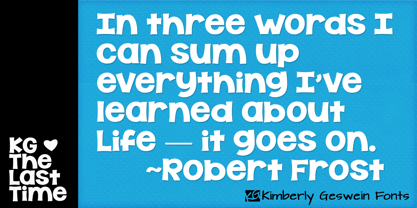
    Playful, whimsical unicase chunky bold lettering.
  39. Hand Scribble Sketch Times by TypoGraphicDesign, $19.00
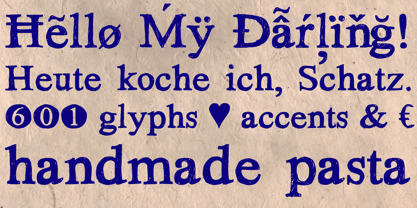
    CHARACTERISTICS A state-of-the-art OpenType-Feature (like Contextual Alternates (calt) and Stylistic Alternates (salt)) of “Hand Scribble Sketch Times” is, that each uppercase and each lowercase letter has automatically alternated two variations to bring humanly-random characteristics of handwriting to life. The cha­rac­ter of the rough, ruggend and raw hand­written classic serif type­face is a very uni­que warmly atmosphere. An pro-version of the font “Hand TIMES”. APPLICATION AREA warmth, love, handmade. For support of human warmth. Of cooking recipes, menus in the restaurant across party flyer, music cover Art to logo (word marks), headings in magazines and websites. TECHNICAL SPECIFICATIONS ? Font Name: Hand Scribble Sketch Times ? Font Weights: Regu­lar, Rough, Invert ? Font Cate­gory: Grunge Serif Dis­play for Head­line Size ? Font For­mat: OTF (Open­Type Font for Mac + Win) ? Glyph cover­age: 601 ? Lan­guage Sup­port: Basic Latin/English let­ters, Cen­tral Europe, West Euro­pean diacri­tics, Bal­tic, Roma­nian, Tur­kish ? Spe­cials: Alter­na­tive let­ters, Standard & Discretionary Ligatures, extras like sym­bols, ding­bats, Old-style Digits, Lining Figures, accents & €, incl. OpenType-Features like Con­text­ual Alter­na­tes (calt), Glyph Composition/Decomposition (ccmp), Dis­cre­tio­nary Liga­tures (dlig), Kerning (kern), Stan­dard Liga­tures (liga), Nume­ra­tors (onum), Ordi­nals (ordn), Sty­listic Alter­na­tes (salt), Stylistic Set 01 (ss01), Stylistic Set 02 (ss02), Stylistic Set 03 (ss03), Slas­hed Zero (zero), Lining Figures (lnum), Tabular Figures (tnum), Old Style Figures (onum), Proportional Figures (pnum) ? Design Date: 2013 ? Type Desi­gner: Manuel Vier­gutz
  40. Old Time Nouveau JNL by Jeff Levine, $29.00
    The 1914 sign lettering instruction book “Art Alphabets and Lettering” by J. M. Bergling showcased many hand lettered alphabets as an inspiration to both up-and-coming and established sign painters. One page in particular featured a classic free-form Art Nouveau style with rounded shapes. This style of lettering was emulated in the 1960s by designers of rock concert posters, so the style is reminiscent of the Art Nouveau period as well as the 1960s. Old Time Nouveau JNL is available in both regular and oblique versions.
Looking for more fonts? Check out our New, Sans, Script, Handwriting fonts or Categories
abstract fontscontact usprivacy policyweb font generator
Processing