2,976 search results (0.017 seconds)
  1. Bellerose - Unknown license
  2. DejaVu Sans Condensed - Unknown license
  3. monofur - Unknown license
  4. Beroga Fettig - 100% free
  5. Cranberry Cyr - Unknown license
  6. Mager - Unknown license
  7. Mops - 100% free
  8. Improvisation - Unknown license
  9. Eau - 100% free
  10. Bertolt Brecht - Unknown license
  11. PTF NORDIC Rnd - Unknown license
  12. Clip - Unknown license
  13. Lamini EQ - Personal use only
  14. id-asobi_LightOT - Personal use only
  15. Retriga - Unknown license
  16. 20th Century Font - Unknown license
  17. BodinSmall - Unknown license
  18. New Cicle - Unknown license
  19. CarawayBold - Unknown license
  20. D3 Roadsterism Wide Italic - Unknown license
  21. Gainsborough - Unknown license
  22. Panther - Unknown license
  23. Perestroika - Unknown license
  24. Héloïse - Unknown license
  25. Scoglietto - Unknown license
  26. Blue Highway D Type - Unknown license
  27. Tristan - Unknown license
  28. M+ 2c - Unknown license
  29. Chachie - Personal use only
  30. Fudd - Unknown license
  31. Bulka - Unknown license
  32. Donaire Black - Personal use only
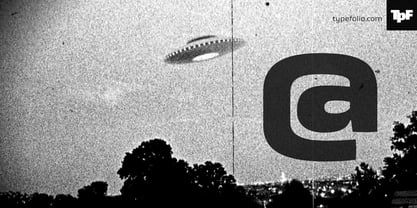
  33. Obvia Wide by Typefolio, $29.00
    'Obvia' appeared as a result of direct observation on typefaces classified as geometric and the plan to explore for the first time width axes Condensed, Narrow (soon), Normal and new Wide and Expanded. The idea behind 'Obvia's design was to create a distancing from geometrically pure shapes, in this case, square shapes. Then some details were added, such as subtle inktraps, concave endings of the stems and carefully drawn alternate characters, giving a 'geohumanist' tone to the font. This first family of 'Obvia' has 9 weights ranging from Thin to Black, delivering a strong typographic identity, from the paper to the pixel.
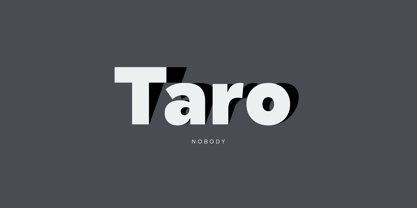
  34. Taro by Dharma Type, $19.99
    Taro Why do designers make more and more geometric fonts? There are already many geometric sans in the world. Because It is a natural flow of design. It is true that we like geometric type instinctively. Taro was designed to archive a good balance between the following three things geometrically. 1. To be Natural, Flowing, Organic. 2. To be Neutral, Unbiased, Universal. 3. To be legible, distinguishable, readable. Consists of eight weights and their matching italics. Supporting almost all latin languages. All-caps text for one line or a few is as wonderful as normal mixed-case typesetting.
  35. 1786 GLC Fournier by GLC, $38.00
    This family was inspired by numerous documents and books printed in Paris during the end of the 1700s. Mainly, documents printed by P.G. Simon & N.H. Nyon, “Printers of the parliament” were used for the Normal and italic styles and “Caps”. “Titling” characters were coming from a collection of hymns printed by Nicolas Chapart. In France these Fournier characters, as Baskerville in Great Britain, were the most often in use in the late 1700s, just before the Didot designs. This font supports strong enlargements, specially the capitals of “Caps” file and “Titling”, remaining very smart, elegant and fine.
  36. Corbert Condensed by The Northern Block, $-
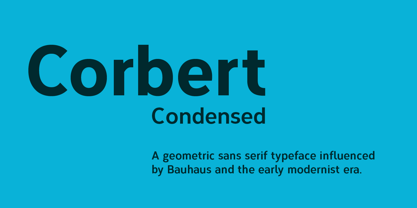
    A condensed sans serif designed as an additional companion to the Corbert font family. Incorporating the key characteristics from the original family with influences drawn strongly from the Bauhaus and modernist era. This condensed version is 15% closer than the normal family improving economy of space across design layouts. Used in conjunction with the regular widths Corbert becomes a functional and versatile font system ideally suited for large complex design projects. Details include 9 weights with italics, 540 characters with alternative lowercase a, e and g, 5 variations of numerals, manually edited kerning and Opentype features.
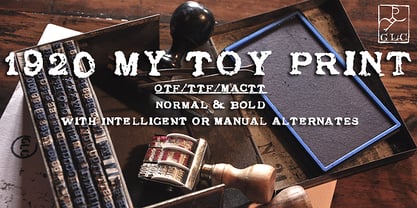
  37. 1920 My Toy Print by GLC, $38.00
    This family was inspired by a small French "toy print" box, with rubber stamp characters, from the 1920s. The set contained only capital letters, no accented letters and limited punctuation. We have reconstituted a complete modern standard set. The doubling of each usual character in each style (A-Z/a-z and numerals) gives a rich and variously uneven appearance, looking like the results of the real use of those old rubber stamps. The bold style may be used as a reinforcement, mixed with Normal style without disadvantage, allowing four choices for each usual letter... The original size is 6mm (about 17 pts).
  38. Obvia Expanded by Typefolio, $29.00
    'Obvia' appeared as a result of direct observation on typefaces classified as geometric and the plan to explore for the first time width axes Condensed, Narrow (soon), Normal and new Wide and Expanded. The idea behind 'Obvia's design was to create a distancing from geometrically pure shapes, in this case, square shapes. Then some details were added, such as subtle inktraps, concave endings of the stems and carefully drawn alternate characters, giving a 'geohumanist' tone to the font. This first family of 'Obvia' has 9 weights ranging from Thin to Black, delivering a strong typographic identity, from the paper to the pixel.
  39. Alpha One by Wiescher Design, $18.00
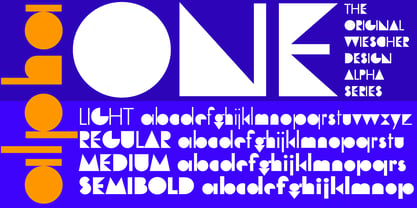
    »AlphaOne« is my newest addition to the experimental Alpha-font-collection. I just had to do this one! It is based on Paul Renners fonts, but has got nothing to do with them, I just took the widths and some basic forms. No – or hardly no – optical corrections were made to the glyphs. I wanted the pure geometric forms to come to life. This was a lot of fun to design, I especially like the »Q« with the negative tail. I did make four weights, but nothing is normal with this font, so weight doesn’t really mean anything. Have fun!
  40. Marconi by Linotype, $29.99
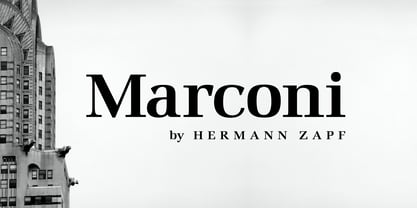
    Marconi was created by Hermann Zapf in 1973. According to Gerard Unger, it was the world's first digital typeface. Zapf’s design was developed as a text face for books and magazines. The round forms of the Marconi follow the principle of the superellipse. The lowercase letters are enlarged as the result of reading tests, while the capital letters are slightly reduced. The 8-point size — normally used for newspapers — looks more like 9 1/2 points. Marconi is a legible typeface with its large and open lowercase letters. It is ideal for long text blocks in newspaper, book, and magazine production.
Looking for more fonts? Check out our New, Sans, Script, Handwriting fonts or Categories
abstract fontscontact usprivacy policyweb font generator
Processing