10,000 search results (0.043 seconds)
  1. Worn Manuscript - Unknown license
  2. Sebaldus-Gotisch - Personal use only
  3. BrokenWoodtypes - Unknown license
  4. Ganz Grobe Gotisch - Personal use only

  5. Durwent - Unknown license
  6. JSL Blackletter - Unknown license
  7. TypographerFraktur Contour - Personal use only
  8. 1492_Quadrata_lim - Unknown license
  9. GF Gesetz - Unknown license
  10. Theodoric - Unknown license
  11. Helldorado - Unknown license
  12. MKBrokenTypes - 100% free
  13. Uberhölme Lazar Condensed - Personal use only
  14. Uberhölme Condensed - Personal use only
  15. Deutschische - Unknown license
  16. Wellsley - Unknown license
  17. Trocadero - Personal use only
  18. Durango Western Eroded - Personal use only

  19. Misuri Club - Personal use only
  20. Hacjiuza Dirty - Personal use only
  21. Tonky - 100% free
  22. DecadentaFrax - 100% free
  23. Durer Gothic - Unknown license
  24. Palatino Nova Paneuropean by Linotype, $67.99
    Palatino® Nova is Prof. Hermann Zapf's redesign of his own masterpiece, Palatino. The original Palatino was cut in metal by August Rosenberger at D. Stempel AG typefoundry in Frankfurt, and released in 1950. Palatino was later adapted for mechanical composition on the Linotype machine, and became one of the most-used typefaces of the 20th Century. Palatino was designed for legibility, and has open counters and carefully weighted strokes. The type was named after Giambattista Palatino, a master of calligraphy from the time of Leonardo da Vinci. Palatino is a typeface based on classical Italian Renaissance forms. A modern classic in its own right, Palatino is popular among professional graphic designers and amateurs alike, working well for both text and display typography. Hermann Zapf and Akira Kobayashi redeveloped Palatino for the 21st Century, creating Palatino Nova. Released by Linotype in 2005, the Palatino Nova family is part of Linotype's Platinum Collection. Palatino Nova includes several weights (Light, Regular, Medium, and Bold), each with companion italics. Four styles (Regular, Italic, Bold, and Bold Italic) have Greek and Cyrillic glyphs built into their character sets. The Palatino Nova family also includes revised versions of Aldus (now called Aldus Nova), as well as two titling weights. The first titling weight, Palatino Nova Titling, is based on Hermann Zapf's metal typeface Michelangelo, including Greek glyphs from Phidias Greek. The heavier titling weight, Palatino Nova Imperial, is based on Sistina. The fonts in the Palatino Nova family support all 48 Western, Central, and Eastern European languages. Additional features: ligatures and historical ligatures, Small Caps, ornaments, and a range of numerals (proportional & tabular width lining and Old style Figures, fractions, inferiors, and superiors)."
  25. Palatino Nova by Linotype, $50.99
    Palatino® Nova is Prof. Hermann Zapf's redesign of his own masterpiece, Palatino. The original Palatino was cut in metal by August Rosenberger at D. Stempel AG typefoundry in Frankfurt, and released in 1950. Palatino was later adapted for mechanical composition on the Linotype machine, and became one of the most-used typefaces of the 20th Century. Palatino was designed for legibility, and has open counters and carefully weighted strokes. The type was named after Giambattista Palatino, a master of calligraphy from the time of Leonardo da Vinci. Palatino is a typeface based on classical Italian Renaissance forms. A modern classic in its own right, Palatino is popular among professional graphic designers and amateurs alike, working well for both text and display typography. Hermann Zapf and Akira Kobayashi redeveloped Palatino for the 21st Century, creating Palatino Nova. Released by Linotype in 2005, the Palatino Nova family is part of Linotype's Platinum Collection. Palatino Nova includes several weights (Light, Regular, Medium, and Bold), each with companion italics. Four styles (Regular, Italic, Bold, and Bold Italic) have Greek and Cyrillic glyphs built into their character sets. The Palatino Nova family also includes revised versions of Aldus (now called Aldus Nova), as well as two titling weights. The first titling weight, Palatino Nova Titling, is based on Hermann Zapf's metal typeface Michelangelo, including Greek glyphs from Phidias Greek. The heavier titling weight, Palatino Nova Imperial, is based on Sistina. The fonts in the Palatino Nova family support all 48 Western, Central, and Eastern European languages. Additional features: ligatures and historical ligatures, Small Caps, ornaments, and a range of numerals (proportional & tabular width lining and Old style Figures, fractions, inferiors, and superiors)."
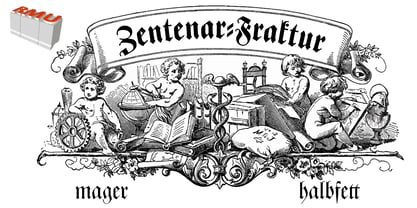
  26. Zentenar Fraktur by RMU, $25.00
    The name of this blackletter font was chosen due to the centennial of the Bauer Foundry, Frankfurt am Mai, in 1937. Ernst Schneidler probably created then the most beautiful of all fraktur fonts. They are the fruit of countless calligraphic drawings and of many years of professional experiences. Zentenar Fraktur became in its time the workhorse among German blackletter fonts. To access all ligatures in both styles, it is recommended to activate Standard and Discretionary Ligatures. The round s can be reached by typing the # key, and the combination N-o-period plus the OT feature Ordinals gives you the Numero sign.
  27. Tresdias - Unknown license
  28. Ekorre PERSONAL USE ONLY Black - Personal use only
  29. Potrzebie - Unknown license
  30. Genghis Khan - Personal use only
  31. LetterOMatic! - Personal use only
  32. Designosaur - 100% free
  33. NFL Falcons - Unknown license
  34. the EV$NT - Personal use only
  35. I Want My TTR! (Condensed) - Unknown license
  36. LC Bagira - Unknown license
  37. Warzone97 - Unknown license
  38. XXII ARMY - Unknown license
  39. PassCaps - Unknown license
Looking for more fonts? Check out our New, Sans, Script, Handwriting fonts or Categories
abstract fontscontact usprivacy policyweb font generator
Processing