10,000 search results (0.021 seconds)
  1. Xenippa - Unknown license
  2. MilleniGem - Personal use only
  3. Jefferson - Unknown license
  4. Mystic Prophet - Unknown license
  5. VTC Embrace - Unknown license
  6. Dwarves - Unknown license
  7. La Flama y La Espina - Personal use only
  8. Gods of War - Unknown license
  9. PiratesOne - Unknown license
  10. Wars of Asgard - Personal use only
  11. Morgow Demo - Unknown license
  12. Crusades - Unknown license
  13. Roman Antique - Unknown license
  14. Vampyres Garden - Unknown license
  15. KleinsBrokenGotik - 100% free
  16. Orchidee - Unknown license
  17. Comic Arousa - Unknown license
  18. Jeff - Unknown license
  19. Art Greco - Unknown license
  20. Varah - Unknown license
  21. Rosemary Roman - Personal use only
  22. Roman Antique - Unknown license
  23. AquilineTwo - Unknown license
  24. Ivanbats - Unknown license
  25. Packard Antique - Personal use only
  26. maran - Unknown license
  27. Zamolxis V - Unknown license
  28. maran - Unknown license
  29. 1492_Quadrata_lim - Unknown license
  30. ARKHAM - Unknown license
  31. Zamolxis III - Unknown license
  32. Elric - Unknown license
  33. ArmadaPirata - 100% free
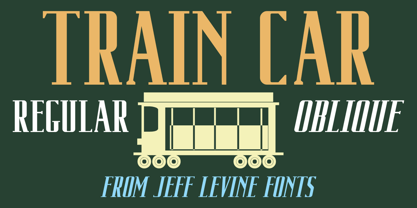
  34. Train Car JNL by Jeff Levine, $29.00
    Hand lettering from the opening credits of Alfred Hitchcock’s “Strangers on a Train” (1951) inspired Train Car JNL, which is available in both regular and oblique versions.
  35. Initials Gothic C by Alter Littera, $15.00
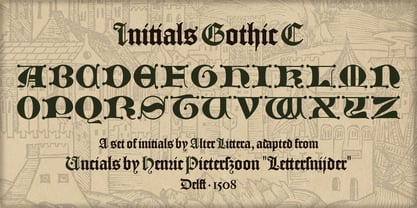
    A comprehensive set of initials (usually referred to as Uncials, Lombardic Initials, or Lombards) of the Germanic variety, designed after Henric Pieterszoon’s “Gothise Monnikke Letteren” as appearing in Enschedé, J. (1768), Proef van Letteren, Haarlem (p. 120); also mentioned as “Great Primer Uncials” and "2-line Brevier Uncials" in Vervliet, H.D.L. (1968), Sixteenth-Century Printing Types of the Low Countries, Amsterdam: Hertzberger (pp. 54-55, and 212-213). The font contains over one hundred glyphs, including as a bonus six layered plus two plain ornamental initials adapted from the Gutenberg Bible (Mainz, ca. 1455) and the Mainz Psalter (Mainz, 1457). Suitable to accompany most Gothic (especially Textura and Rotunda) typefaces, or to be displayed as drop caps or in full titles and headings. Specimen, detailed character map, OpenType features, and font samples available at Alter Littera’s The Initials “Gothic C” Font Page. Note: Several uncial initials in The Oldtype “Psalterium” Font have been derived from corresponding characters in The Initials “Gothic C” Font, adjusting them to cope with the special (large) x-height and letter spacing of the Psalterium font (so the two sets of initials are not directly interchangeable).
  36. Funny Book Sans by G. Alex Gonzalez, $20.00
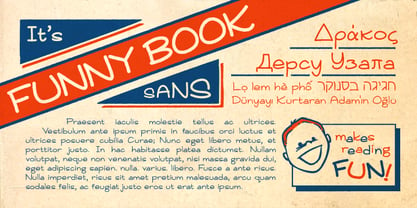
    Funny Book Sans includes these codepages: 1252 Latin 1; 1250 Latin 2: Eastern Europe; 1251 Cyrillic; 1253 Greek; 1254 Turkish; 1255 Hebrew; 1257 Windows Baltic; 1258 Windows Vietnamese.
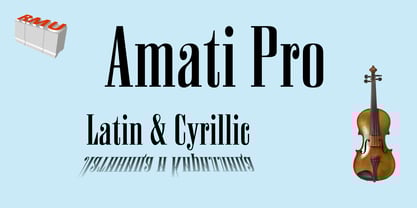
  37. Amati Pro by RMU, $40.00
    A revived and updated version of Georg Trump's Amati which was first released by C. Weber Foundry, Stuttgart, in 1951. A compressed multilingual serif font for many purposes.
  38. New Journal by ParaType, $30.00
    The typeface was designed at the Polygraphmash type design bureau in 1951-53 by Lev Malanov, Elena Tsaregorodtseva et al. Based on Cyrillic version of Excelsior, 1931, of Mergenthaler Linotype, by Chauncey H. Griffith. Excelcior Cyrillic was developed in 1936 in Moscow by Professor Michael Shchelkunov, Nikolay Kudryashev et al. A low-contrast text face of the Ionic – "Legibility" group.
  39. DIN Neue Roman by Vibrant Types, $43.00
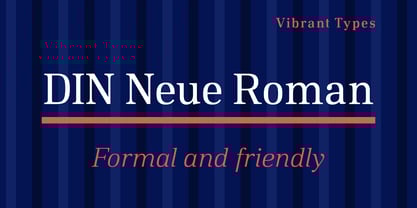
    The DIN Neue Roman adds something new to the established concept of the DIN 1451 type’s technical origin. As a serif counterpart it leaves its static appeal to bring some friendliness into this industrial idea. With more contrast than a slab serif and the dynamic stroke of transitional type DIN Neue Roman defies all conventions, but keeps its legibility. To have enough resources for diverse and complex typography this type family offers 7 weights with italics, small caps and all kind of opentype features. Type designer Philip Lammert likes to play with the great potential of contradictions. That brought him to this design combining two essentially different classics. DIN Neue Roman is part of his 2015’s master thesis at the HAW Hamburg which was supervised by Prof. Jovica Veljovic.
Looking for more fonts? Check out our New, Sans, Script, Handwriting fonts or Categories
abstract fontscontact usprivacy policyweb font generator
Processing