10,000 search results (0.023 seconds)
  1. Apollyon™ - Unknown license
  2. Biergärten - Personal use only
  3. Chipperfield_and_Bailey - Unknown license
  4. Uberhölme Italic - Personal use only
  5. KleinsBrokenGotik - 100% free
  6. HerzogVonGraf - 100% free
  7. PerryGothic - Unknown license
  8. Gothic Texture Quadrata - Unknown license
  9. Meyne Textur - 100% free
  10. Uberhölme Lazar Italic - Personal use only
  11. SchmalfetteGotisch - 100% free
  12. Manticore - Unknown license
  13. Morris Roman Alternate - Personal use only
  14. Freak Show - Unknown license
  15. BigElla - 100% free
  16. Worn Manuscript - Unknown license
  17. Sebaldus-Gotisch - Personal use only
  18. BrokenWoodtypes - Unknown license
  19. Ganz Grobe Gotisch - Personal use only

  20. Durwent - Unknown license
  21. Trocadero - Personal use only
  22. JSL Blackletter - Unknown license
  23. TypographerFraktur Contour - Personal use only
  24. 1492_Quadrata_lim - Unknown license
  25. GF Gesetz - Unknown license
  26. Theodoric - Unknown license
  27. Helldorado - Unknown license
  28. MKBrokenTypes - 100% free
  29. Uberhölme Lazar Condensed - Personal use only
  30. Uberhölme Condensed - Personal use only
  31. Deutschische - Unknown license
  32. Wellsley - Unknown license
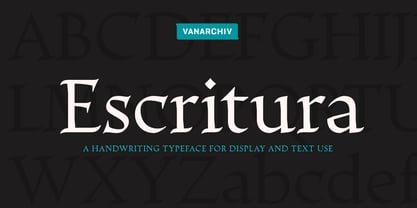
  33. Escritura by Vanarchiv, $30.00
    The handwriting typeface Escritura was created for editorial purposes and the letter forms are influenced by chancery handwriting from the Italian Renaissance. The asymmetrical shapes of the undulating serifs cause the characters to have a large aperture. Originally designed for display sizes, the typeface also comes in a text version for small sizes. With taller vertical proportions, the text version has slightly longer serifs and increased white space between the characters to optimize legibility in small sizes. Ascenders and descenders and serifs are shorter in the display version, which has more economical letter spacing resulting in a visually compact text image. The stress in the letter strokes create changing widths according to their direction, improving the calligraphic rhythm in the characters. The oblique crossbar as well as other typographic details lend the typeface that typical Renaissance atmosphere.
  34. Serapion by Storm Type Foundry, $39.00
    Another variation on the Renaissance-Baroque Roman face, it extends the selection of text type faces. In comparison with Jannon, the contrast within the letters has been enhanced. The dynamic elements of the Renaissance Roman face have been strengthened in a way which is illustrated best in the letters "a", "b" and "s". These letters contain, in condensed form, the principle of this type face - in round shapes the dark stroke invariably has a round finial at one end and a sharp one at the other. Another typical feature is the lower-case "g"; the upper part of this letter consists of two geometrically exact circles, the inner of which, a negative one, is immersed down on the right, upright to the direction of the lower loop and the upright knob. The vertical strokes slightly splay out upwards. Some details of the upper-case letters may seem to be too daring, but they are less apparent in the text sizes. It has to be admitted that typographers tend to draw letters in exaggerated sizes, as a result of which they stick to details. Serapion Italic are italics inspired partly by the Renaissance Cancelleresca. This is obvious from the drop-shaped finials of its lower-case descenders. The type face is suitable for illustrated books, art posters and short texts. It has a rather ugly name - after St. Serapion.
  35. Mantika Book by Linotype, $50.99
    Mantika Book was originally conceived and drawn parallel to the first Agilita drawings. *[images: pencil drawings] It took several years before having a chance looking at these designs again. But then, my first impulse was to turn this alphabet into a new sanserif, which was to become Mantika Sans. This was the starting point to conceive a super family consisting of different design styles and corresponding weights. The initial drawings of Mantika Book were refined and an Italic was developed to go with it. The aim was to create a modern serif typeface which is reminiscent of humanistic Renaissance typefaces, yet without following a particular historic model. Its large x-height for one is far away from original Renaissance models. Mantika Book was designed as a companion serif typeface to Mantika Sans that can be set for lengthy texts as in books, hence its name. It shares the same x-height with Mantika Sans but has longer ascenders and descenders, making for better word shapes in long, continuous reading. The approach of an ›old-style‹ looking typeface with large minuscules makes Mantika Book also a choice for magazine text settings where one often needs smaller point sizes to fit in a multiple columns layout. The unique details of Mantika Book are the asymetric bracketed serifs in the upright font and its higher stroke contrast than usual in a Renaissance style. The stems are slightly curved inwards. Also, the Italics have a low degree of inclination, which makes longer passages of text set in Italic rather pleasing to read. Another feature Mantika Book shares with Mantika Sans is that all four weights take up the same line length. It covers all European languages plus Cyrillic and Greek, is equipped with lots of useful scientific symbols [double square brackets, angle brackets, empty set, arrows] and the regular weight has small caps. There is a kind of an old-style feeling to Mantika Book, yet these citations were turned into a contemporary serif typeface with a soft but sturdy character.
  36. Misuri Club - Personal use only
  37. Hacjiuza Dirty - Personal use only
  38. Tonky - 100% free
  39. DecadentaFrax - 100% free
Looking for more fonts? Check out our New, Sans, Script, Handwriting fonts or Categories
abstract fontscontact usprivacy policyweb font generator
Processing