10,000 search results (0.016 seconds)
  1. Zud Juice - Personal use only
  2. Anime Ace - Personal use only
  3. Keelhauled BB - Personal use only
  4. Fanboy Hardcore - Personal use only
  5. Chronicles of a Hero - Personal use only
  6. Mainframe BB - Personal use only
  7. SchnoerkelCaps - 100% free
  8. Poultrygeist Out - Unknown license
  9. Bazaronite - Unknown license
  10. Twelve Ton Fishstick - Personal use only
  11. WebLetterer BB - Personal use only
  12. BottleRocket BB - Personal use only
  13. Zud Juice - Personal use only
  14. CrimeFighter BB - Personal use only
  15. Mighty Zeo 2.0 - Personal use only
  16. Oh Crud BB - Personal use only
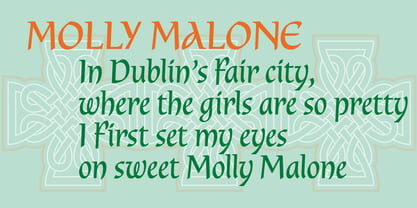
  17. Dublin by Alan Meeks, $45.00
    Classic Celtic style of lettering with an alternative set of capitals and a few alternative lower case.
  18. Interboro JNL by Jeff Levine, $29.00
    Interboro JNL is based on the serif lettering found on an old E-Z Letter lettering guide.
  19. Liana by ParaType, $25.00
    The typeface was created for TypeMarket in 1998 by Natalia Vasilyeva. Based on Lainie of Soft Horizons.
  20. DF Daantje by Dutchfonts, $16.00
    The DF-Daantje is an icon font based on a brisk black creature: our Fell Terrier ‘Daantje’.
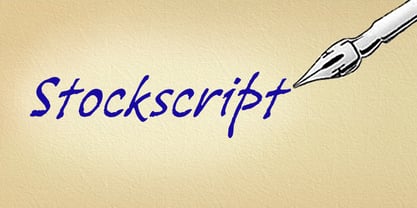
  21. Stockscript by K-Type, $20.00
    An elegant yet down-to-earth script based on the pen lettering of the writer, Christopher Stocks.
  22. Radiant by Red Rooster Collection, $45.00
    Designed by R.H. Middleton. Digitally engineered by Steve Jackaman. Based on the original Ludlow drawings, circa 1938.
  23. Craw Clarendon by Wooden Type Fonts, $15.00
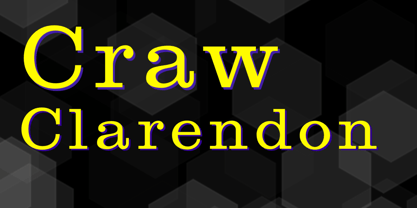
    One of the many Clarendon font designs, this one based in part on the Craw Clarendon design.
  24. Raleigh Gothic by Red Rooster Collection, $45.00
    Based on the ATF typeface by Morris F. Benton, circa 1934. Steve created two additional new weights.
  25. Northfork JNL by Jeff Levine, $29.00
    Northfork JNL is based on a William H. Page wood type alphabet called Parisian, circa 1857-58.
  26. Gargoyle by Red Rooster Collection, $45.00
    Based on an Adrian Williams design, circa 1976 and Brook Type in 1903 designed by Lucien Pissaro.
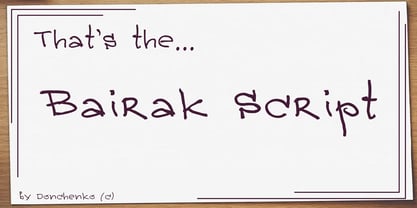
  27. Bairak Script by Donchenko, $10.00
    This typeface was created based on the handwriting of the famous Ukrainian bard and artist Viktor Bairak.
  28. Enochian Writing by Deniart Systems, $10.00
    Based on the magical writing system originated by Dr. John Dee and Edward Kelly in Elizabethan England.
  29. Betico's Hand by Corradine Fonts, $14.95
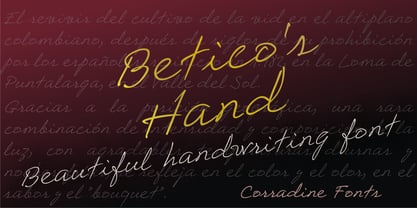
    Betico’s Hand is based in Elberto Roman’s handwriting. It could be used even in a formal project.
  30. Home Field JNL by Jeff Levine, $29.00
    Home Field JNL is a sports-oriented font based on the lettering found in Directory Board JNL.
  31. Palatino Nova Paneuropean by Linotype, $67.99
    Palatino® Nova is Prof. Hermann Zapf's redesign of his own masterpiece, Palatino. The original Palatino was cut in metal by August Rosenberger at D. Stempel AG typefoundry in Frankfurt, and released in 1950. Palatino was later adapted for mechanical composition on the Linotype machine, and became one of the most-used typefaces of the 20th Century. Palatino was designed for legibility, and has open counters and carefully weighted strokes. The type was named after Giambattista Palatino, a master of calligraphy from the time of Leonardo da Vinci. Palatino is a typeface based on classical Italian Renaissance forms. A modern classic in its own right, Palatino is popular among professional graphic designers and amateurs alike, working well for both text and display typography. Hermann Zapf and Akira Kobayashi redeveloped Palatino for the 21st Century, creating Palatino Nova. Released by Linotype in 2005, the Palatino Nova family is part of Linotype's Platinum Collection. Palatino Nova includes several weights (Light, Regular, Medium, and Bold), each with companion italics. Four styles (Regular, Italic, Bold, and Bold Italic) have Greek and Cyrillic glyphs built into their character sets. The Palatino Nova family also includes revised versions of Aldus (now called Aldus Nova), as well as two titling weights. The first titling weight, Palatino Nova Titling, is based on Hermann Zapf's metal typeface Michelangelo, including Greek glyphs from Phidias Greek. The heavier titling weight, Palatino Nova Imperial, is based on Sistina. The fonts in the Palatino Nova family support all 48 Western, Central, and Eastern European languages. Additional features: ligatures and historical ligatures, Small Caps, ornaments, and a range of numerals (proportional & tabular width lining and Old style Figures, fractions, inferiors, and superiors)."
  32. Palatino Nova by Linotype, $50.99
    Palatino® Nova is Prof. Hermann Zapf's redesign of his own masterpiece, Palatino. The original Palatino was cut in metal by August Rosenberger at D. Stempel AG typefoundry in Frankfurt, and released in 1950. Palatino was later adapted for mechanical composition on the Linotype machine, and became one of the most-used typefaces of the 20th Century. Palatino was designed for legibility, and has open counters and carefully weighted strokes. The type was named after Giambattista Palatino, a master of calligraphy from the time of Leonardo da Vinci. Palatino is a typeface based on classical Italian Renaissance forms. A modern classic in its own right, Palatino is popular among professional graphic designers and amateurs alike, working well for both text and display typography. Hermann Zapf and Akira Kobayashi redeveloped Palatino for the 21st Century, creating Palatino Nova. Released by Linotype in 2005, the Palatino Nova family is part of Linotype's Platinum Collection. Palatino Nova includes several weights (Light, Regular, Medium, and Bold), each with companion italics. Four styles (Regular, Italic, Bold, and Bold Italic) have Greek and Cyrillic glyphs built into their character sets. The Palatino Nova family also includes revised versions of Aldus (now called Aldus Nova), as well as two titling weights. The first titling weight, Palatino Nova Titling, is based on Hermann Zapf's metal typeface Michelangelo, including Greek glyphs from Phidias Greek. The heavier titling weight, Palatino Nova Imperial, is based on Sistina. The fonts in the Palatino Nova family support all 48 Western, Central, and Eastern European languages. Additional features: ligatures and historical ligatures, Small Caps, ornaments, and a range of numerals (proportional & tabular width lining and Old style Figures, fractions, inferiors, and superiors)."
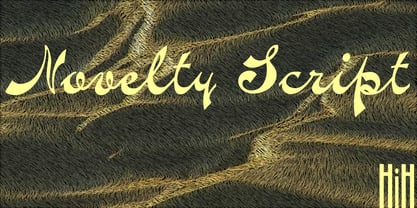
  33. Novelty Script by HiH, $10.00
    Novelty Script is a bold dynamic script, sharply delineated, yet fluid. Most of the lower case letters and many of the upper case letters have joins. The typeface was designed by Nicholas J. Werner and Gustave F. Schroeder and patented in March 1893. The original release was by the Central Type Foundry of St. Louis, Missouri. Although a part of ATF from 1892, the Central Type Foundry continued to operate under its own name until 1895. Novelty Script uses our new encoding, as noted in the All_customer_readme.txt. The Euro symbol has been moved to position 128 and the Zcaron/zcaron have been added at positions 142/158 respectively. Otherwise, Novelty Script has our usual idiosyncratic glyph selection, with the German ch/ck instead of braces, Western European accented letters, lower case “o” and “u” with Hungarian umlaut and our usual Hand-in-Hand symbol. But that is not all. With the takeover of the Central Type Foundry by ATF, a group of special characters appeared. All are included in this font, except the “&Co” and the "'s", for a total of nine in all. The “Ch” and “nd” ligatures are especially interesting because of the impact they have on the color and overall appearance of the page. Download the PDF Type Specimen for locations. This is a fun font to use. Its strength is print, where it gives a page a refreshing look. The joins sometimes have difficulty on the screen, in spite of extensive hinting. Playing around with small changes on the point size can pay dividends. Not for the faint-of-heart. Are you up to the challenge?
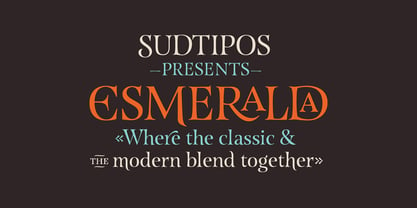
  34. Esmeralda Pro by Sudtipos, $59.00
    From the beginning “Esmeralda” was born with a strong influence of the classical “capitalis monumentalis”, carved in stone. In the same way, the origin of this majuscule writing emerged from the brush, from a way of writing made merely by hand. For this reason, these two universes were intended to lie beneath the shape of each letter, redefining them. And this combination of styles should also be reflected in a lower case set that also allows to open up the spectrum of usage possibilities. Foundational calligraphy represented a solid base for the development of lower case glyphs, ensuring proper interaction with the upper case letters. “Esmeralda” features a great number of ligatures that mix classic structures with a more contemporary impression. With more than eleven hundred glyphs, it provides a multiplicity of uses across a wide combinatory of ligatures, alternative signs, initial caps, miscellaneous and connectors; each one of them accessible through Open Type. “Esmeralda” is perfect to speak with a classical yet fresh, modern – and a little bit bold – tone of voice. Designed by Guille Vizzari, together with the tough and remarkable work of Ale Paul, in use “Esmeralda” stands out in a subtle and unexpected way that’s almost unnoticeable. Its delicate yet solid curves, serifs and endings give each composition a fine, elegant and exquisite feeling, along with a firm and sturdy look. “Esmeralda” was initially born as a typographic project developed by Guillermo Vizzari – tutored by Ale Paul and Ana Sanfelippo – under completion of the Specialization in Typography Design at University of Buenos Aires, Argentina, during the years 2011 and 2012.
  35. Homoarakhn - Unknown license
  36. Kid Kosmic - Personal use only
  37. Gorilla Milkshake - Personal use only
  38. Orange Fizz - Personal use only
  39. Kid Kosmic - Personal use only
  40. LetterOMatic! - Personal use only
Looking for more fonts? Check out our New, Sans, Script, Handwriting fonts or Categories
abstract fontscontact usprivacy policyweb font generator
Processing