1,842 search results (0.015 seconds)
  1. Monkey-Fingers - Unknown license
  2. Chelsea Studio - Unknown license
  3. FeteAccompli - Unknown license
  4. HeraldSquare - Unknown license
  5. NouveauRiche - Unknown license
  6. Paris - Unknown license
  7. Eglantine - Unknown license
  8. Goddard Demo - Unknown license
  9. Mirisch - Personal use only
  10. Harri - Unknown license
  11. Titanick-Display - Unknown license
  12. Planet Dust - Unknown license
  13. Ouijadork - Unknown license
  14. Nightcap - 100% free
  15. Urkelian Television Dynasty - Unknown license
  16. SpeedballNo2SW - Unknown license
  17. RitzyNormal - 100% free
  18. Arwen - Unknown license
  19. Tortillon Tryout - Unknown license
  20. AmsterdamTangram - Unknown license
  21. French Grotesque - Unknown license
  22. Ganelon Demo - Unknown license
  23. Munich - Unknown license
  24. DosEquis - 100% free
  25. Caeldera - Personal use only
  26. Scalactic J - Unknown license
  27. Le Film - Unknown license
  28. Deco Cafe - Unknown license
  29. Fortunaschwein - Unknown license
  30. Metropolitaines by Linotype, $29.99
    This art nouveau style typeface is the one that had been used for the signage of the historic Paris metro stations.
  31. Fleurons of Paris by Outside the Line, $19.00
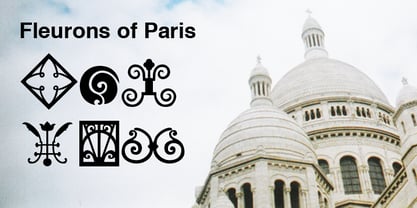
    The Fleurons of Paris were inspired by an iron gate, an iron railing, a Metro tile, a Metro stop, the Eiffel Tower, Notre Dame, a rainy afternoon, a glass of wine, an outdoor cafe and the list goes on and on. Absorbing all things visual was immensely satisfying second only to coming home and reliving the trip tiny graphic by tiny graphic. Also look at the Ornaments of Paris.
  32. Metroblack #2 by Linotype, $29.00
    American graphic designer William Addison Dwiggins' (W.A.D. for short) first typefaces were the Metro family, designed from 1927 onward. The project grew out of Dwiggins' dissatisfaction with the new European sans serif typefaces of the day, such as Futura, Erbar, and Kabel, a feeling he expressed in his seminal book Layout in Advertising. Urged by Mergenthaler Linotype to create a solution for the problem, Dwiggins began a professional relationship that would span over the next few decades. The first Metro family typeface to be released was Metroblack, brought to market by Linotype in 1929 (Metroblack #2™ the only one of the two versions that Mergenthaler Linotype eventually put into production which is available in digital form). With more of a humanist quality than the geometric styles popular in Europe at the time, Dwiggins drew what he believed to be the ideal sans serif for headlines and advertising copy. Metroblack has a warmer character than the Modernists' achievements, and the type is full of mannered curves and angled terminals (Metroblack also has an astoundingly beautiful Q). The weights of the Metro family, Metromedium #2™ and Metrolite #2™, were each designed by Mergenthaler Linotype's design office under Dwiggins' supervision. In 2012 Toshi Omagari reworked the Metro family as "Metro Nova" with many weights into a modern type family that even contains the alternate characters from the origin Metro family from Dwiggins. Despite having been created more than three-quarters of a century ago, the Metro family types have aged well, and remain a popular sans serif family. Although spec'd less often than other bestsellers, like Futura, Metro continues to find many diverse uses. The typeface has appeared throughout Europe and the North America for decades in newspapers and magazines, and can even help create a great brand image when used in logos and corporate identity. Dwiggins ranks among the most influential graphic designers and typeface designers of the 20th Century. He has several other quality fonts in the Linotype portfolio, including the serif text faces Electra™ and New Caledonia™, as well as Caravan™, a font of typographic ornaments.
  33. Whitenow by Proportional Lime, $15.99
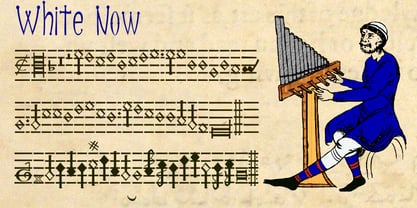
    In the year 1528 Pierre Attaignant led a revolution in music printing. His method of once-press moveable type, greatly simplifying the original 3 impression process developed by Petrucci, remained in use till near the end of the 17th century. The method could only realize one line of music per staff, and the introduction of barlines as a common means of aligning multiple staves brought this method to a close after nearly two centuries of use. This font is meant to allow the printing of music using that method with the notation of that era. It is largely based on an exemplar printed by Snodham of London.
  34. Paris Doodles by Outside the Line, $19.00
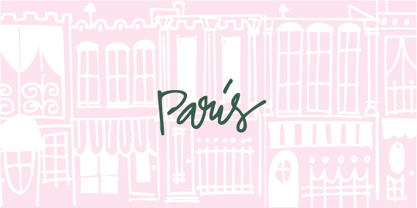
    Paris Doodles... memories of a feeling, a rainy afternoon, a glass of wine, an outdoor cafe, a metro stop… 28 hand drawn whimsical icons and 2 scripted words. Ooh la la!
  35. DR Kruk Single by Dmitry Rastvortsev, $49.99
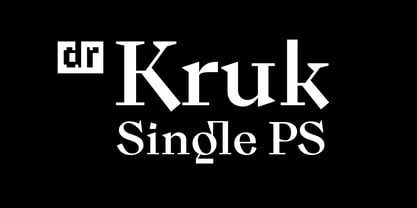
    Honorable Mention at Morisawa Type Design Competition 2019 (Tokyo, Japan).
  36. Freeform 721 by Bitstream, $29.99
    Auriol font was the basis for the lettering used by Hector Guimard for the entrance signs to the Paris Metro. Bitstream’s Freeform 721 with his brush stroke look, is well-suited to display settings.
  37. Royal Serif - Personal use only
  38. Mouse Deco - Personal use only
  39. Jet Set Groove - Personal use only
  40. Renny Hybrid - 100% free
Looking for more fonts? Check out our New, Sans, Script, Handwriting fonts or Categories
abstract fontscontact usprivacy policyweb font generator
Processing