9,477 search results (0.02 seconds)
  1. MonoAlphabet - 100% free
  2. Lintsec - Unknown license
  3. EileenCaps - Unknown license
  4. Oregon - Unknown license
  5. Opulent - Unknown license
  6. Nova - Unknown license
  7. IGaramond - Unknown license
  8. Pointage - Unknown license
  9. Averoigne - Unknown license
  10. Comics - Unknown license
  11. Isotype - Unknown license
  12. Patron - Personal Use - Personal use only
  13. VTC Krinkle-Kut - Unknown license
  14. VTC Letterer Pro - Unknown license
  15. VTC Bad DataTrip - Unknown license
  16. VTC SikleCell - Unknown license
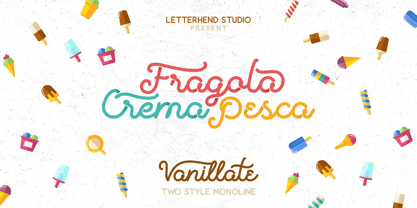
  17. Vanillate by Letterhend, $10.00
    Vanillate is a unique monoline script typeface with two styles of monoline. This font is comes in uppercase, lowercase, punctuation, symbols, numerals, stylistic set alternate, and ligatures. This consist of 4 fonts: Vanillate Regular that is the regular version of this font. Vanillate Alt is the regular version with an overlapping effect. Vanillate Rounded is the regular version with rounded edge. Vanillate Rounded Alt is the rounded version with an overlapping effect on it.
  18. Warlock - Unknown license
  19. Oracle - Unknown license
  20. Rockmaker - Unknown license
  21. Cardinal - Personal use only
  22. Stone - Unknown license
  23. Rock-A-Billy - Unknown license
  24. MarkerFinePoint-Plain - Unknown license
  25. NeedlePointSew-Plain - Unknown license
  26. Ian - Unknown license
  27. Juliet - Unknown license
  28. Cupertino - Unknown license
  29. OregonDry-Plain - Unknown license
  30. Walrod - Unknown license
  31. VTC Bad DataTrip - Unknown license
  32. VTC Anglika Bent - Unknown license
  33. Moire by Microsoft Corporation, $39.00
    Moireâ„¢ Regular is a block-style sans serif font designed by Jim Ford in the spirit of typefaces popular during the 1950's. The Moire Regular font is slightly more streamlined for a more contemporary voice than its predecessors. Moire Regular is useful for all modern display settings in signs, publications, reports and presentations. The Moire Regular font will also reproduce well in on-screen uses from User Interfaces to web graphics. Character set: Latin 1.
  34. Armalite Rifle Pro by CheapProFonts, $10.00
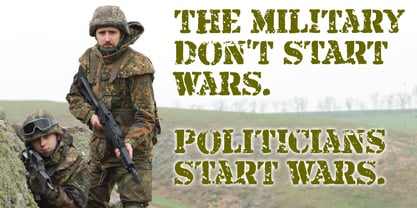
    Military style stencil type, badly bruised by shotgun fire, wear and tear. Now ready for action in more languages! Vic Fieger says: "The original letterforms were not the famous military stencil, but were drawn freehand then scanned into Photoshop. Next, they were altered using a series of brushes before being imported into a font. This font has been used in the Flash games Pandemic and Artillery." ALL fonts from CheapProFonts have very extensive language support: They contain some unusual diacritic letters (some of which are contained in the Latin Extended-B Unicode block) supporting: Cornish, Filipino (Tagalog), Guarani, Luxembourgian, Malagasy, Romanian, Ulithian and Welsh. They also contain all glyphs in the Latin Extended-A Unicode block (which among others cover the Central European and Baltic areas) supporting: Afrikaans, Belarusian (Lacinka), Bosnian, Catalan, Chichewa, Croatian, Czech, Dutch, Esperanto, Greenlandic, Hungarian, Kashubian, Kurdish (Kurmanji), Latvian, Lithuanian, Maltese, Maori, Polish, Saami (Inari), Saami (North), Serbian (latin), Slovak(ian), Slovene, Sorbian (Lower), Sorbian (Upper), Turkish and Turkmen. And they of course contain all the usual "Western" glyphs supporting: Albanian, Basque, Breton, Chamorro, Danish, Estonian, Faroese, Finnish, French, Frisian, Galican, German, Icelandic, Indonesian, Irish (Gaelic), Italian, Northern Sotho, Norwegian, Occitan, Portuguese, Rhaeto-Romance, Sami (Lule), Sami (South), Scots (Gaelic), Spanish, Swedish, Tswana, Walloon and Yapese.
  35. In 1931, The Times of London commissioned a new text type design from Stanley Morison and the Monotype Corporation, after Morison had written an article criticizing The Times for being badly printed and typographically behind the times. The new design was supervised by Stanley Morison and drawn by Victor Lardent, an artist from the advertising department of The Times. Morison used an older typeface, Plantin, as the basis for his design, but made revisions for legibility and economy of space (always important concerns for newspapers). As the old type used by the newspaper had been called Times Old Roman," Morison's revision became "Times New Roman." The Times of London debuted the new typeface in October 1932, and after one year the design was released for commercial sale. The Times New Roman World Version is an extension of the original Times New Roman with several other scripts like with the Helvetica World fonts. It is part of the Windows Vista system. The following code pages are supported:1250 Latin 2: Eastern European 1251 Cyrillic 1253 Greek 1254 Turkish 1255 Hebrew 1256 Arabic Note: The Roman and Bold versions include the arabic scripts but they are not part in the corresponding italic versions. 1257 Windows Baltic 1258 Windows Vietnamese
  36. Best Choice Demo - Personal use only
  37. Basic Map - Personal use only
  38. KellyAnnGothic - Unknown license
  39. LaurenScript - Unknown license
  40. PerryGothic - Unknown license
Looking for more fonts? Check out our New, Sans, Script, Handwriting fonts or Categories
abstract fontscontact usprivacy policyweb font generator
Processing