10,000 search results (0.13 seconds)
  1. Teutonic No1 - Unknown license
  2. Ginebra Bolds - Unknown license
  3. Clingy - Unknown license
  4. Sisters - Unknown license
  5. Syntax Error - Unknown license
  6. Mufferaw - Unknown license
  7. Raiderz - Unknown license
  8. Grace - Unknown license
  9. Kremlin Orthodox Church - Unknown license
  10. Hobbes - Unknown license
  11. Futurex Narrow - Unknown license
  12. Komika Krak - Unknown license
  13. reflet électrik - Personal use only
  14. Usenet - Alternates - Unknown license
  15. Gravel - Unknown license
  16. Se7en - Unknown license
  17. Prussian Brew Upper - Unknown license
  18. WAD - Unknown license
  19. Kwekel - Unknown license
  20. Doggy - Unknown license
  21. Amerika Alternates - Unknown license
  22. Searching - Unknown license
  23. Wee Bairn - Unknown license
  24. Garcon - Unknown license
  25. Almonte Snow - Unknown license
  26. Concrete Shoes - Unknown license
  27. Paxil Initials - Unknown license
  28. Hyrule - Personal use only
  29. Zomnk - Unknown license
  30. Amerika Sans - Unknown license
  31. Newfie - Unknown license
  32. Kandide - Unknown license
  33. Peabody - Unknown license
  34. Frantic - Unknown license
  35. Serene Textured by Pedro Teixeira, $14.00

    Serene Textured Script is informal, good for logos, headlines in magazines or titles in food recipes with a slight retro feel and textured that add value to your designs.
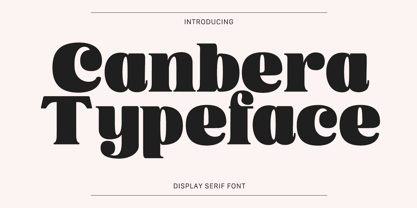
  36. Canbera by Viswell, $19.00
    Canbera is an old style serif font, its funky, round, hight-contrast and bold shape with a retro touch is perfect for displayed, head text, logotype and many more.
  37. FF Rain - Personal use only
  38. Durango Western Eroded - Personal use only

  39. Mauritius by Canada Type, $29.95
    Ten years or so after his unique treatment of Garalde design with Trump Mediaeval, Georg Trump took on the transitional genre with Mauritius, which was to be his last typeface. He started working on it in 1965. The Stuttgart-based Weber foundry published a pamphlet previewing it under the name Barock-Antiqua in 1967, then announced the availability of the metal types (a roman, a bold and an italic) a year later. The global printing industry was already in third gear with cold type technology, so there weren't that many takers, and Weber closed its doors after more than 140 years in business. Subsequently, Trump’s swan song was unfairly overlooked by typography historians and practitioners. It never made it to film technology or scalable fonts. Thus, one of the most original text faces ever made, done by one of the most influential German type designers of the 20th century, was buried under decades of multiple technology shifts and fading records. The metal cuts of Mauritius seem to have been rushed in Weber’s desperation to stay afloat. So the only impressions left of the metal type, the sole records remaining of this design, show substantial problems. Some can be attributed to technological limitations, but some issues in colour, precision and fitting are also quite apparent, particularly in Mauritius Kursiv, the italic metal cut. This digital version is the result of obsessing over a great designer’s final type design effort, and trying to understand the reasons behind its vanishing from typography’s collective mind. While that understanding remains for the most part elusive, the creative and technical work done on these fonts produced very concrete results. All the apparent issues in the metal types were resolved, the design was expanded into a larger family of three weights and two widths, and plenty of 21st century bells and whistles were added. For the full background story, design analysis, details, features, specimens and print tests, consult the PDF available in the Gallery section of this page.
  40. Ambassador Script by Canada Type, $69.95
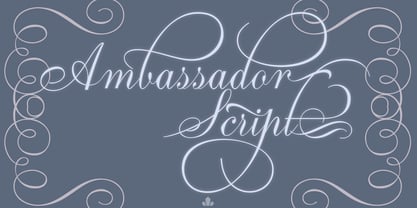
    When Aldo Novarese designed his “tipo inglese” Juliet typeface, he had a simple objective in mind: Reduce the inclination angle of the traditional 18th and 19th centuries English script in order to make the punchcutter’s job easier and the resulting metal type more durable. But when Juliet was released by Nebiolo in 1955, it was a big surprise to both typesetters and calligraphers all over Europe. Novarese’s idea of working the standard copperplate script within the limited technology of the time proved to be a marvel in optical metal sizing (Juliet was available in sizes ranging from 12 to 60 pt), but also opened the door to new calligraphic possibilities. Easier readability and a very friendly color were obvious side effects of the reduced angle. So soon after its release, calligraphers worldwide began emulating the angle reduction and experimenting with the application of the same concept to other calligraphic genres. Today, more than 50 years later, many professional calligraphers point to Novarese’s Juliet as an opening to fresh ideas and new directions in 20th century elegant calligraphy. Ambassador Script, this digital version of Aldo Novarese’s surprising masterpiece, is the result of more than a thousand hours of work. Going above and beyond its duty as a revival, it was expanded by a great number of alternates, swashes, beginning and ending forms, as well as accompanying flourishes and snap-on strokes for even more ending forms. Ambassador Script also supports almost every known Latin-based language, which makes its name all the more fitting. Ambassador Script is available in all popular font formats. The True Type and Postscript Type 1 versions come in 12 fonts, available in different piecemeal configurations or a full volume. The OpenType version collects more than 2300 characters in a single feature-rich font that can sing mightily in OpenType-supporting applications. Ambassador Script is ideal for weddings, invitations, greeting cards, book and magazine covers, or anywhere a touch of calligraphic elegance is desired.
Looking for more fonts? Check out our New, Sans, Script, Handwriting fonts or Categories
abstract fontscontact usprivacy policyweb font generator
Processing