6,821 search results (0.029 seconds)
  1. Compliant Confuse 2o BRK - Unknown license
  2. SF Wonder Comic Blotch - Unknown license
  3. Compliant Confuse 1o BRK - Unknown license
  4. SF Wonder Comic Blotch - Unknown license
  5. Compliant Confuse 2s BRK - Unknown license
  6. Compliant Confuse 3s BRK - Unknown license
  7. Compliant Confuse 3o BRK - Unknown license
  8. Wonders Graf 3d Graffiti by Sipanji21, $15.00
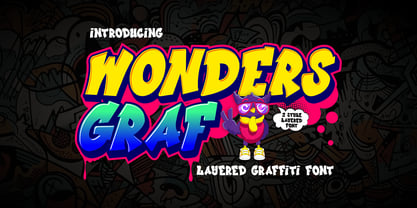
    "Wonder Graff" is a graffiti font that features 3 different layers and multiple font styles. With these layers and font style variations, you can create intriguing effects in your design. The use of layers and font styles allows you to achieve more complex and creative looks. Fonts like "Wonder Graff" are often used in street art, posters, or designs that want to emphasize bold and energetic typography. With different layer and style options, you have greater control over the appearance of your text and can customize it to fit your design concept.
  9. Gogobig by Bogusky 2, $25.00
    I have always been frustrated when looking for a bold condensed face. The choices were the usual? Helvetica Bold Condensed, Univers Bold Condensed or Alternate Gothic #2... all rather dated. I was looking for a really unique, clean, uncluttered sans serif face, so I decided to design one. I have since adapted it to many logo designs. So, in my terms and conditions, I decided to permit the modification of the letter forms for logos and monograms, but logos and monograms only, not the typeface in normal usage.
  10. SF Movie Poster - Unknown license
  11. Flemish-Normal - Unknown license
  12. Wolf's Bane Pro - Personal use only
  13. GranthamCondensed - Unknown license
  14. Vahika - Personal use only
  15. Ben Cat Normal - Unknown license
  16. GranthamLightCondensed - Unknown license
  17. Klytus - Unknown license
  18. Komikazoom - Unknown license
  19. Pecot - Unknown license
  20. GranthamCondensed - Unknown license
  21. Walkway UltraCondensed Bold - Unknown license
  22. Walkway UltraCondensed Semi - Unknown license
  23. Walkway UltraCondensed - Personal use only
  24. Source Code Pro - 100% free
  25. Cone Of Silence - Unknown license
  26. Covington SC Cond - Unknown license
  27. Avondale SC Cond - Unknown license
  28. Covington SC Cond - Unknown license
  29. Covington SC Cond - Unknown license
  30. Avondale SC Cond - Unknown license
  31. Covington SC Cond - Unknown license
  32. Frigate Katakana - Cond - Unknown license
  33. Sassoon Primary Cond by Sassoon-Williams, $48.00
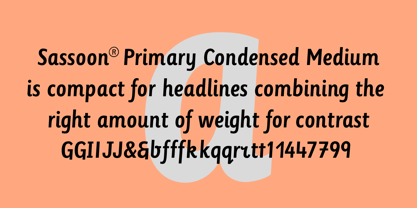
    Those who design books for young children should consider the different needs of their readers. When laying out pages for young readers, particular care should be taken over word spacing. Don't forget that justifying short lines disrupts spacing. Justification should be used only when absolutely necessary. In the research undertaken with young readers the importance of consistent spacing was clear. It also appeared that the poorer readers profited from wider word spacing, while spacing that suited the poorest readers, positively annoyed the better readers. These typefaces have built-in letter spacing because of their exit strokes, as well as extra clarity designed into them. Sassoon Primary Medium Condensed is a compact style for headlines combining the right amount of weight, yet in a friendly style. When used at large sizes the friendliness of Sassoon types really shines. Why not use it for headings throughout a book. You can find many other new ways to use this typeface. Ideal perhaps for the masthead or a magazine? Free to download resources: How to access Stylistic Sets of alternative letters in these fonts
  34. Project Of Code by Putracetol, $22.00
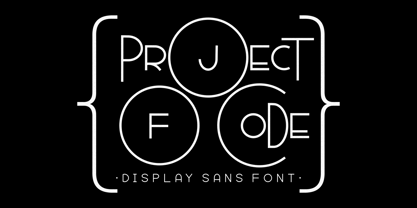
    Project Of Code - Display Sans Font. Project Of Code a contemporary, Display Sans inspired display typeface full of character, quirky ligatures, and glyphs to keep your designs fresh. Project Of Code is a display font that we recommend using in the following types of work; magazines (titles and layouts), logos and branding, invitations, quotes, blog headers, posters, and advertising. The alternative characters were divided into several Open Type features such as Swash, Stylistic Sets, Stylistic Alternates, Contextual Alternates, and Ligature. The Open Type features can be accessed by using Open Type savvy programs such as Adobe Illustrator, Adobe InDesign, Adobe Photoshop Corel Draw X version, And Microsoft Word. This font is also support multi language.
  35. National Codes Pi by Monotype, $29.00
  36. AF Zip Code by ACME Collection, $44.00
  37. XIntnl Morse Code by Ingrimayne Type, $6.95
    I designed a Morse-Code font in the mid 1990s, but when I decided to update it, I found enough problems with it to completely redo it. I hope I got all the mistakes out. There are two fonts in the package. One of them shows the letter key with the Morse Code equivalent.
  38. Aaux Next Cond by Positype, $22.00
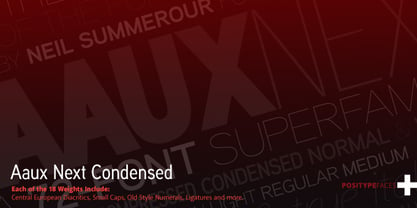
    When the original Aaux was introduced in 2002, I intended to go back and expand the family to offer more versatility. Years went by before I was willing to pick it up again and invest the proper time into building a viable and useful recut. Just putting a new designation and tweaking a few glyphs here and there would not do the designer or the typeface justice; instead, I chose to redraw each glyph's skeleton from scratch for the four main subsets of the super family along with their italics. Each glyph across the super family is 'connected at the hip' with each style—each character carries the no frills, simple architecture that endeared so many users to it. The new recut expands the family to an enormous 72 typefaces! The original has spawned Compressed, Condensed and Wide subsets—all with corresponding weights—for complete flexibility. Additionally, all of the original weight variants have all been incorporated within the OpenType shell: Small Caps and Old Style Figures are there along with new tabular figures, numerators and denominators, expanded f-ligatures and a complete Central European character set.
  39. Typist Code Mono by VanderKeur, $25.00
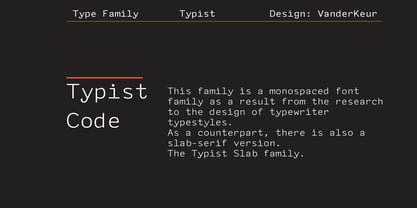
    The typeface Typist originated during an extensive research on the origin and development of typewriter typestyles. The first commercially manufactured typewriter came on the market in 1878 by Remington. The typestyles on these machines were only possible in capitals, the combination of capitals and lowercase came available around the end of the nineteenth century. Apart from a few exceptions, most typestyles had a fixed letter width and a more or less unambiguous design that resembled a thread-like structure. A lot of this mechanical structure was due to the method the typestyles were produced. Looking at type-specimens for print before the first typewriters were good enough to came on the market we can see that in 1853 and in 1882 Bruce’s Type Foundry already had printing type that had a structure of the typewriter typestyles. Of course printing types were proportional designed as typewriter typestyles had a fixed width. So it is possible that except from the method of production for typewriter typestyles, the design of printing types were copied. In the design of the Typist, the purpose was – next to the monospace feature – to include some of the features of the early typewriter typestyles. Features such as the ball terminals and the remarkable design of the letter Q. This new typeface laks the mechanical and cold look of the early typewriter typestyles. The Typist comes in six weights with matching italics in two versions. One that resembled the early typewriter typestyles (Typist Slab) and a version designed with coding programmers in mind (Typist Code).
Looking for more fonts? Check out our New, Sans, Script, Handwriting fonts or Categories
abstract fontscontact usprivacy policyweb font generator
Processing