10,000 search results (0.035 seconds)
  1. Bottix - Personal use only
  2. Mage 1999 - Unknown license
  3. UglyQua - 100% free
  4. Christian Crosses V - Unknown license
  5. Monkey Chunks - Unknown license
  6. SunriseSunset - Unknown license
  7. Halter Pinchy - Unknown license
  8. Oloron Tryout - Unknown license
  9. AngeGardien - Unknown license
  10. StandingRoomOnly - Unknown license
  11. Aquarium - Unknown license
  12. Nixon - Unknown license
  13. Embossing Tape 2 (BRK) - Unknown license
  14. Inked - Unknown license
  15. Final Fantasy - Unknown license
  16. Shazbot - Unknown license
  17. DS Thompson - Unknown license
  18. KR Trick Or Treat - Unknown license
  19. Bandwidth BRK - Unknown license
  20. Slinked - Unknown license
  21. Gaheris Demo - Unknown license
  22. KR Crayons - Unknown license
  23. KR Katlings - Unknown license
  24. Lounge Bait - Personal use only
  25. Chibaraki Now - Unknown license
  26. LetterOMatic! - Personal use only
  27. Kefka - Unknown license
  28. Stonecross - Unknown license
  29. Kremlin Kourier II - Unknown license
  30. BluePlateSpecialSW - Unknown license
  31. CharlieChan - Unknown license
  32. Covington SC Shadow - Unknown license
  33. Upheaval TT BRK - Unknown license
  34. Gold Year Personal Use - Personal use only
  35. Maketa - Personal use only
  36. AringtonDemo - Personal use only
  37. Figgins Tuscan by HiH, $12.00
    Early in the 19th century, foundries began releasing a variety of decorated ornamental letters based on the Tuscan letterform. Fancy Tuscan letters quickly became so popular, they eventually came to represent the cluttered extremes of Victorian design. Foundries competed with each other to produce most extravagantly decorated letterforms. As often happens, success turned to excess. What is often overlooked is the long history of the Tuscan style. Early examples have been traced back to ancient Rome. Indeed, the characteristic bifurcation may have represented a fishtail to the early Christians, thus sharing in the roll of symbolic identification played by the simple drawing of a fish as a whole. Later. trifurcation was developed as an alternate termination, followed by loops, full fishtails, curls, hooks and other fancy variations. Nicolete Gray provides an extensive history in her Appendix One of NINETEENTH CENTURY ORNAMENTED TYPEFACES. According to Gray, the first metal typeface based on the Tuscan form was the Ornamented of 1817 by Vincent Figgins of London. Thorowgood followed suit in 1821, Fry in 1824 and Caslon in 1830. Each was to re-visit the form many times during the Victorian era. Here we present our interpretation of what Figgins might have produced in a basic, plain Tuscan form - free of the decorative additions. We are pretty safe here because Figgins was very creative. He explored many of the terminal variations listed above and combined them with different decorative devices to produce a constant stream of new faces to meet the demands of the marketplace. Figgins Tuscan ML represents a major extension of the original release, with the following changes: 1. Added glyphs for the 1250 Central Europe, the 1252 Turkish and the 1257 Baltic Code Pages. There are also a few glyphs for Anglo-Saxon, Gaelic and Old Gaelic. Total of 355 glyphs. 2. Added OpenType GSUB layout features: aalt, ornm and liga ˜ with total 34 lookups. 3. Added 351 kerning pairs. 4. Redesigned several glyphs: the comma, quotes, brackets, braces, acute accent, and grave accent. 5. Revised vertical metrics for improved cross-platform line spacing. Please note that some older applications may only be able to access the Western Europe character set (approximately 221 glyphs). The zip package includes two versions of the font at no extra charge. There is an OTF version which is in Open PS (Post Script Type 1) format and a TTF version which is in Open TT (True Type)format. Use whichever works best for your applications.
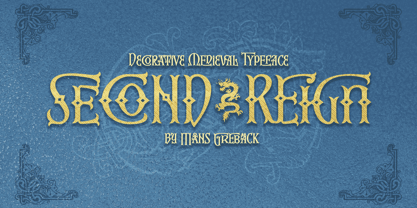
  38. Second Reign by Mans Greback, $59.00
    Second Reign is a decorative medieval typeface. With borders and diamonds, this magic typeface of extreme variability brings us to glorious worlds in the golden times of epic sagas. Second Reign is the typeface of a viking king or a knight order. Use it for a Middle Ages game, a fantasy headline, or as a logotype for anything of historical theme. With usage in any modern software, the letters will automatically overlap and embrace in an elegant way. To make heraldic symbols, copy these icons: 🐉 🐎 👑 🗡 🦁 🦅 🦌 + ♖ × ✝ ⚓ * ⚔ † ‡ Alternatively write %A %B %C ... etc to create the heraldry. (Download required.) Dragon, Horse, Crown, Sword, Eagle, Deer, Cross, Anchor are some of the logos. Use [ ] for side borders. Example: [Royal⚔Thrones] The Second Reign family consists of four variations: The weight styles Thin, Medium and Bold, plus the decorated Border style. The font is built with advanced OpenType functionality and has a guaranteed top-notch quality, containing stylistic and contextual alternates, ligatures and more features; all to give you full control and customizability. It has extensive lingual support, covering Greek and Cyrillic, as well as all Latin-based languages, from North Europe to South Africa, from America to South-East Asia. It contains all characters and symbols you'll ever need, including all punctuation and numbers.
Looking for more fonts? Check out our New, Sans, Script, Handwriting fonts or Categories
abstract fontscontact usprivacy policyweb font generator
Processing