10,000 search results (0.039 seconds)
  1. CODE3X - Unknown license
  2. Fh_Perception - Personal use only
  3. Baumarkt - Unknown license
  4. Two Tones - Unknown license
  5. Circuitry - Unknown license
  6. Tasmin Ref - Unknown license
  7. winob - Unknown license
  8. Blocked Off - Personal use only
  9. Concielian Break - Unknown license
  10. Quark Outline - 100% free
  11. GAU_font_modern - Unknown license
  12. Deng Thick - Unknown license
  13. Induction - Unknown license
  14. Shadow of Xizor - Unknown license
  15. Hackers - Unknown license
  16. Spacebeach - Personal use only
  17. CARMEN - Unknown license
  18. Quadaptor - Unknown license
  19. Moby - Unknown license
  20. Ben Brown - Unknown license
  21. Shoguns Clan - Unknown license
  22. Tozuna - Personal use only
  23. Lady Ice - 3D - Unknown license
  24. Masterforce Solid - Unknown license
  25. Rasstapp 1.0 - Unknown license
  26. XPED Bold - Unknown license
  27. Alphabeta - Unknown license
  28. Big Blocko - Unknown license
  29. 11.20 - Unknown license
  30. Perolet - Unknown license
  31. Clearblock circular - Unknown license
  32. Romance Fatal Sans - Personal use only
  33. SF Willamette - Unknown license
  34. Ubahn - 100% free
  35. SF Diego Sans - Unknown license
  36. Venus Rising - Unknown license
  37. Walkway Condensed SemiBold - Unknown license
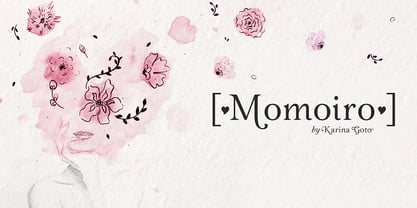
  38. Momoiro by Underground, $29.00
    Momoiro is a feminine typeface family, designed for editorial use. "The first case in which appeared a fashion content in a magazine was in 1672 in the magazine Le Mercure Galant, which was a magazine of entertainment and varied content, including fashion. But the first illustrated and specialized magazine was Le Journal Des Dammes Et Des Modes, created in 1797. "(Fashion Trends, 2011). On the basis of this historical period, the creation of typography has characteristics of a Baroque type. "In this category we mainly include the types created in the Netherlands during the seventeenth century and whose protagonists are the punch makers Reinhard Voskens and Christoffel Van Dijck. Baroque typography stands out for its accentuated play of irregular axes and contrasts that permeate the text of great vividness. " Therefore it has contrast in the thick and thin strokes, Roman serifs, humanistic axis. With this typography, we are not looking for a re-reading of the baroque, but rather a current typeface with humanistic characteristics of the handwriting, with a brush as a differential. Momoiro comes in two weights plus italics to cover as much design needs as possible. It compliments from OpenType features such as ligatures, swashes, true fractions, old style numerals and stylistic sets.
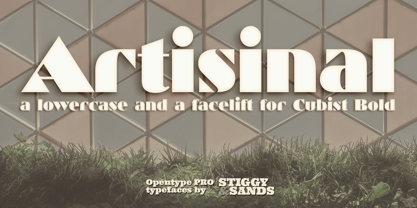
  39. Artisinal by Stiggy & Sands, $24.00
    Artisinal, not to be confused with the term artisanal, is our revival of the Art Deco typeface known as Cubist Bold, by John W. Zimmerman for Barnhardt Bros. & Spindler in 1929, breathes new life into a classic. The original metal cast typeface was designed without a lowercase, as well as some wedge serif capitals made for not always perfect pairings. We've created a lowercase that blends well with the original design to give the typeface more usability. We've also created a fully sans version of the capitals as the default set, and moved the original wedge serif capital styles to a contextual alternates feature. And we created a few stylistic alternates for lowercase characters like the u and y and their accented styles. See the 5th graphic for a comprehensive character map preview. Opentype features include: - Full set of Inferiors and Superiors for limitless fractions. - A Standard lining figure set. - A collection of basic f Ligatures. - Stylistic Alternates for variations of several characters such as u and y. - Contextual Alternates for the original wedge variations of capitals that will mix in where appropriate. Approx. 450 Character Glyph Set: Artisinal comes with a glyph set that includes standard & punctuation, international language support, and additional features
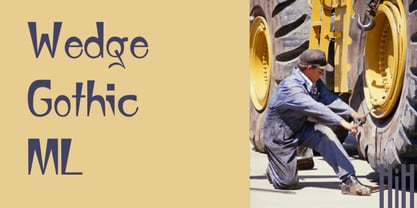
  40. Wedge Gothic by HiH, $12.00
    Bold, muscular, vaguely oriental, Wedge Gothic ML is the original name of this font released by Barnhart Bros. and Spindler of Chicago in 1893. The straight-forward, no-nonsense name tells us exactly what to expect: sans-serif letterforms based on wedge-shaped vertical strokes. The typeface was dropped for awhile -- it does not appear in the 1907 catalog for example -- but reappeared in 1925 as Japanette. What is the opposite of "straight-forward" anyway? According to McGrew, Wedge Gothic was originally created for the Chicago Herald newspaper. The designer is unknown. A distinctive display face, useful when a strong and unusual statement is desired. Wedge Gothic ML features: 1. Glyphs for the 1250 Central Europe, the 1252 Western Europe, the 1254 Turkish and the 1257 Baltic Code Pages. Total of 335 glyphs. 2. OpenType GSUB layout features: pnum, ornm, hist & salt. 3. 66 kerning pairs. 4. Both tabular & proportional numbers. 5. Alternate bullets. The zip package includes two versions of the font at no extra charge. There is an OTF version which is in Open PS (Post Script Type 1) format and a TTF version which is in Open TT (True Type)format. Use whichever works best for your applications.
Looking for more fonts? Check out our New, Sans, Script, Handwriting fonts or Categories
abstract fontscontact usprivacy policyweb font generator
Processing