9,102 search results (0.047 seconds)
  1. SF Beaverton - Unknown license
  2. TypographerFraktur - Unknown license
  3. Orbitron - 100% free
  4. Shady Characters - Unknown license
  5. Hinwil - 100% free
  6. DS UncialFunnyHand - Unknown license
  7. SF Beaverton SC - Unknown license
  8. Capitalis Goreanis - 100% free
  9. Waxtrax - Unknown license
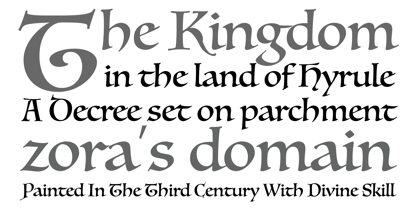
  10. Luminari by Canada Type, $29.95
    Philip Bouwsma returns with yet another great manifestation of historical calligraphy. Luminari is an amalgam of High Middle Ages writing, a blend that combines the ornate Church hands with the simple Carolingian from the ninth to the fifteenth centuries. Its majuscules are particularly influenced by the versals found in the famous Monmouth psalters, as well as those done by the Ramsey Abbey abbots in the twelfth century. The minuscules also exhibit some influence from the book hand of prolific humanist Poggio Bracciolini from the early fifteenth century. Italian and essentially romanesque in style, Luminari exercises a slight tension between the round forms and the angular “gothic” styling. Luminari was updated with plenty of alternates and expanded language support in 2012. It now supports a very wide range of codepages, including Cyrillic, Greek, Central and Eastern European, Turkish, Baltic, Vietnamese, and of course Celtic/Welsh.
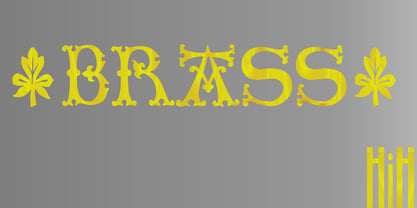
  11. Brass by HiH, $8.00
    The Brass Family has a lineage that extends into English history. About five hundred years ago a devout, but anonymous Englishman gave glory to the God he worshipped by designing the capital letters and decorations of these two fonts. Originally recorded in The History Of Mediaeval Alphabets And Devices by Henry Shaw (London 1853), they are described by Alexander Nesbitt in his Decorative Alphabets And Initials (Mineola, NY 1959) as “Initials and stop ornaments from brasses in Westminster Abbey.” I wish I could say I remember seeing them when I was there, but that was forty-two years ago and all I remember was seeing the tomb of Edward the Confessor. One definition of “stop” as a noun is a point of punctuation. I have heard people from the British Isles speak of a “full stop” when referring to a period. Some may remember a 19th century form of communication called a telegram being read aloud in an old movie, with the use of the word “stop” to indicate the end of a sentence or fragment. A full dozen of these stop ornaments are provided. They occupy positions 060, 062, 094, 123, 125, 126, 135, 137, 167, 172, 177 & 190. The Brass Family consists of two fonts: Brass and Brass Too. Both fonts have an identical upper case and ornaments, but paired with different lower cases. Although the typefaces from which the lower cases were drawn are both of modern design, both are interpretations of the textura style of blackletter in use in England when the upper case and ornaments were fashioned for the Abbey. Brass is paired with Morris Gothic, which matches the color of the upper case quite well. Brass Too is paired with Wedding Regular, which is distinctly lighter than the upper case. I find it very interesting how each connects differently. The resulting fonts are unusual and most useful for evoking an historic atmosphere.
  12. Ambient - Unknown license
  13. Backfire - Unknown license
  14. Hill House - 100% free
  15. XiparosLombard - Unknown license
  16. RoadSign - Unknown license
  17. Sweetheart Script - Personal use only
  18. DS Dots - Unknown license
  19. TypographerFraktur - Unknown license
  20. Livia - Unknown license
  21. Bughouse - Unknown license
  22. Neuropol - Unknown license
  23. Paperclip Reg - Unknown license
  24. Storyteller - Personal use only
  25. DS Rabbit - Unknown license
  26. Saginaw - Unknown license
  27. Beffle - Unknown license
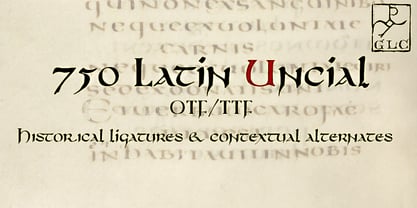
  28. 750 Latin Uncial by GLC, $38.00
    This font was inspired by the Latin script used in European monasteries from circa the 5th to 8th centuries, before the Carolingian “Caroline” (look at our 825 Karolus). It was a regular script, rounded, written slowly, used mainly for specially meticulous books, with a few ligatures, legible, but only with lowercase. The capitals consisted of enlarged lower cases, but here, we have preferred to use two slightly different patterns. Our lower cases are a synthesis from a lot of variants (mainly from the “First Bible” of Charles The Bald), the upper cases were mainly inspired from a 700’s manuscript from the abbey of Fécamp (France). We have adapted the font for contemporary users, differentiating between U and V, I and J, which has no relevance for ancient Latin scribes, and naturally with Thorn, Oslash, Lslash, K, W... punctuation and the usual accented characters which did not exist at the time. It can be used with 799 Insular Title.
  29. Kidnap Note - Personal use only
  30. Comic Relief - Personal use only
  31. Seeds Cyr - Unknown license
  32. DS Sholom - Unknown license
  33. Kovensky-small - Unknown license
  34. Midiet - 100% free
  35. HeiS ASC Simplified Chinese by Ascender, $523.99
    HeiS ASC Medium is a Simplified Chinese font supporting GB2312. The HeiS ASC Medium font is a sans serif style typeface with consistent strokes. HeiS ASC Medium font character Set: Latin-1, Simplified Chinese (code page 936).
  36. Midiet - 100% free
  37. DNNR - Personal use only
  38. AgitProp - Unknown license
  39. Omellons - Unknown license
  40. Coffeehouse - Unknown license
Looking for more fonts? Check out our New, Sans, Script, Handwriting fonts or Categories
abstract fontscontact usprivacy policyweb font generator
Processing