10,000 search results (0.023 seconds)
  1. NoodleScript - Unknown license
  2. Cursive Handwriting Tryout - Unknown license
  3. Especial Kay - Unknown license
  4. fragments of eter - Unknown license
  5. JaneAusten - Unknown license
  6. Want You Back - Unknown license
  7. Licorice Strings BRK - Unknown license
  8. Allembert™ - Unknown license
  9. PrestonScript - Unknown license
  10. Hyrule - Personal use only
  11. G-Unit - Unknown license
  12. A Yummy Apology - Personal use only
  13. Delicious - Personal use only
  14. Sisterhood - Personal use only
  15. Better Days - Personal use only
  16. Scarlett Busiat_Demo - Personal use only
  17. Ript Cure by insigne, $19.99
    RiptCure is a futuristic, but usable typeface for everything from logotypes to magazine headlines. Several weights are included, including an interesting Ultra Light.
  18. Comic Strip MN - Unknown license
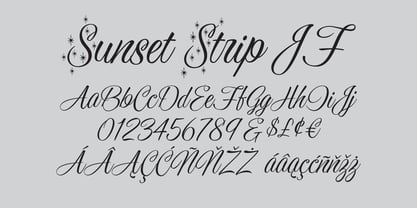
  19. Sunset Strip JF by Jukebox Collection, $36.99
  20. EF BANANA Strip by Elsner+Flake, $35.00
  21. Temet Nosce by Artisticandunique, $25.00
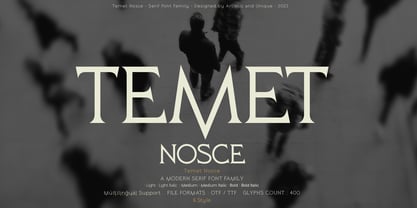
    Temet Nosce - Serif font family - Multilingual - 6 Styles Temet Nosce Serif font family help you develop your creative projects with its 6 styles and multilingual supports. It was inspired by the famous saying from ancient Greek mythology. The characters that make up its structure were influenced by the carved letters in the old stone inscriptions. According to ancient Greek and Roman authors, there were three maxims prominently inscribed upon the Temple of Apollo at Delphi: "know thyself", "nothing too much" and "give a pledge and trouble is at hand". Their exact location is uncertain; they are variously stated to have been on the wall of the pronaos (forecourt), on a column, on a doorpost, on the temple front, or on the propylaea (gateway). The date of their inscription is also unknown, but they were present at least as early as the 5th century BC. Although the temple was destroyed and rebuilt several times over the years, the maxims appear to have persisted into the Roman era (1st century AD), at which time, according to Pliny the Elder, they were written in letters of gold. This font comes with uppercase, lowercase, punctuation, symbols and numbers, ligatures and multilingual supports. Ideal for books and magazines, editorials, headlines, websites, logos, branding, advertising and more. This font family can meet your needs in all creative projects, modern and classic. With this font you can create your unique designs. Have a good time.
  22. Do I like Stripes? - Unknown license
  23. Peter Jessen Schrift Pro by SoftMaker, $10.99
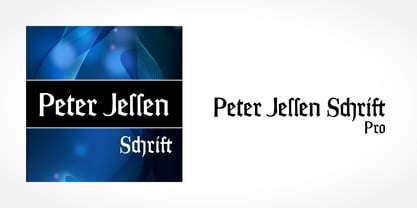
    Blackletter is the classic “German” printing type. Starting in the 16th century and lasting well into the 20th century, most works in Germany were printed using blackletter types.Today, blackletter fonts are mainly used decoratively. If you want to communicate a feeling of old-world quality or nostalgia, blackletter fonts are the preferred choice – use them on signs, in brochures or on invitation cards. “Peter Jessen Schrift Pro” is a classic blackletter font of its epoch which inspires you to create vintage-looking designs with ease.
  24. KG Candy Cane Stripe by Kimberly Geswein, $5.00
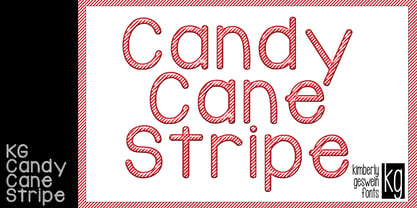
    A happy candy cane striped font. Don't get stuck in a holiday only mode with this one- it is versatile enough for many uses.
  25. P22 St G Schrift by IHOF, $39.95
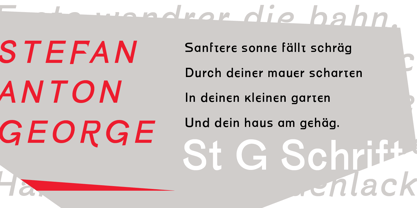
    P22 ST.G Shrift is a font series based on the type designs of Stefan George with an italic version designed by Colin Kahn. Stefan George (1868-1933) was a German poet who led the revolt against realism in German literature. All of his works were privately published and the typefaces that were used reflected his neo-classic and anti-industrial (progessive) aesthetics; oftentimes consisting of his own hand lettering designs. The original font was cast in 1907 by a small foundry in Germany and was used primarily for the works of George as well as other books including a monumental edition of Dante's Divine Comedy. The ST.G Shrift Fonts contained in this set are derived from 3 known variations of the original roman typeface, St.G., found in various books published in Berlin in the early 20th century. ST.G Shrift One contains the most idiosyncratic characters, while ST.G Shrift Two uses more familiar characters as well as a redesign of characters including the t and the k to be more in keeping with modern san-serif designs. The OpenType version of the roman contains both one and two and expands on them by including central European characters, small caps, and small caps titling figures. The Small Caps titling figures are derived from the first version of the typeface. Below is a features list (accessible through the type palette in Adobe programs) and their functions: ST.G Shrift Opentype Features: Small Caps: Changes Lowercase to Small Caps Titling Figures: Changes Uppercase to Titling Caps, and Small Caps to Small Caps Titling Figures Contextual Alternates: Changes Character Set to match ST.G One and changes Small Caps to Titling Small Caps Ornaments: Changes < > and ? (greater, less and bullet) to ornaments ST.G Shrift Italic is an art nouveau version of the roman. The OpenType version includes central European characters, small caps, titling caps, titling small caps and ornaments.
  26. Nordic - Unknown license
  27. Gismonda - Unknown license
  28. Amelia - Unknown license
  29. Relate - Personal use only
  30. Last Dream - Personal use only
  31. Network Free - Personal use only
  32. Lighthouse Personal Use - Personal use only
  33. Promocyja - Unknown license
  34. Gessele - Unknown license
  35. Shardee - Unknown license
  36. Jolgoria in Town - Personal use only
  37. Jellyka, Saint-Andrew's Queen - Personal use only
  38. Blods - Personal use only
  39. Kingthings Wrote - 100% free
  40. Platthand Demo - Unknown license
Looking for more fonts? Check out our New, Sans, Script, Handwriting fonts or Categories
abstract fontscontact usprivacy policyweb font generator
Processing