10,000 search results (0.028 seconds)
  1. Best Choice Demo - Personal use only
  2. KG Ways to Say Goodbye - Unknown license
  3. Unity Dances - Personal use only
  4. VTCTattooScriptTwo - Personal use only
  5. flower1 - Unknown license
  6. Feast of Flesh BB - Personal use only
  7. Tropicana - Unknown license
  8. Coming Home - Personal use only
  9. Neighbourhood - 100% free
  10. chalkie - Unknown license
  11. Swinging - 100% free
  12. Crown Doodle {denne} - Unknown license
  13. Guede Demo - Unknown license
  14. indezonefont - creative - Unknown license
  15. !Sketchy Times - Unknown license
  16. Monster boxes - Personal use only
  17. Pinocchio - Unknown license
  18. somalove - Personal use only
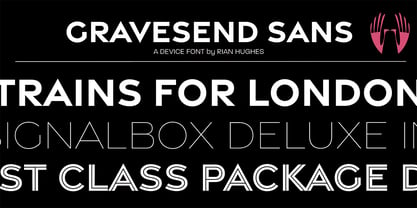
  19. Gravesend Sans by Device, $39.00
    Smart, legible and elegant, Gravesend Sans is a based on the unique typeface used for the iconic grass-green signage for the Southern Railway. In existence from 1923 to 1948, when the network was nationalised, the Southern Railway linked London with the Channel ports, South West England, the South coast resorts and Kent. The same design was also used for the ‘hawkeye’ signs on the London, Midland and Scottish Railway, differentiated by black letters on a yellow background. Reference for each letter was taken from vintage ‘target’ station nameplates and other platform signage. The rarest letters were the Q, seen in Queens Road Battersea, the X, seen in East Brixton, and the Z, used in Maze Hill, site of an infamous train crash in 1958. Being hand-made, the letters often differ in width and thickness. There was no lower case. The Bluebell Railway, a heritage steam line, runs over part of the old Southern Railway network and uses a very similar type. The design of the numbers differed considerably, but here have been taken from the Device 112 Hours font Smokebox. As well identifying platforms, they were used on the front of the steam engine’s smokebox, hence the name, and stylistically are more in keeping with the letters than some of the squarer versions that can be seen in old photographs. William Caslon IV is credited with the first Latin sans-serif type, shown in a 1816 Caslon specimen book. ‘Two Lines English Egyptian’, as it was called, was caps-only, and there are several other correlations between that type design and this one. Includes a selection of authentic arrows and manicules, plus abbreviated ligatures such as ‘St.’ (Saint or Street) ‘Rd.’ (Road) and ‘Jn.’ (Junction). The Cameo version includes many graphic banner elements that can be freely combined.
  20. Jatina Script - Personal use only
  21. Ananda Black Personal Use - Personal use only
  22. Adigiana Ultra - 100% free
  23. Magic Owl Personal Use - Personal use only
  24. Cartoo Nature - Personal use only
  25. SkyFall Done - Personal use only
  26. Cheri Liney - Personal use only
  27. 13_Roshi - Personal use only
  28. Anastasia - Unknown license
  29. Prognostic - Personal use only
  30. WhoopAss - Personal use only
  31. Beautiful Beasts - Unknown license
  32. Pea Bethany's Doodles - Unknown license
  33. Brushstroke Plain - Unknown license
  34. Instant Soup Mix - Unknown license
  35. PiratesTwo - Unknown license
  36. Fish in the bathroom - Unknown license
  37. Skeleton Sketched - 100% free
  38. Chemical Gus - Unknown license
  39. QuickKleinSketches - 100% free
Looking for more fonts? Check out our New, Sans, Script, Handwriting fonts or Categories
abstract fontscontact usprivacy policyweb font generator
Processing