10,000 search results (0.034 seconds)
  1. 101! Shooting StarZ - Unknown license
  2. basmati - Unknown license
  3. Pulse State - Unknown license
  4. Megaton Extras - 100% free
  5. 101 Punkin Pie - Unknown license
  6. Aleia - Unknown license
  7. 101 Zebra Print - Unknown license
  8. Accidental Presidency - Unknown license
  9. Alba Matter - Personal use only
  10. Eglantine - Unknown license
  11. 101 Anuther PictoBet - Unknown license
  12. Pontifica Demo - Unknown license
  13. I2technoBrush - Unknown license
  14. Jambon - Unknown license
  15. Eager Naturalist - Unknown license
  16. Munchkins - Unknown license
  17. Vertical Tuning - Unknown license
  18. Monoglyceride - Unknown license
  19. Pussycat - Personal use only
  20. KR Crow - Unknown license
  21. Matchbox - Unknown license
  22. Model Worker - Unknown license
  23. JW Brass - Unknown license
  24. Electamine - Unknown license
  25. Sujeta - Unknown license
  26. Discognate Light - Unknown license
  27. Yellow Pills - Unknown license
  28. CloseCall - Unknown license
  29. Squarodynamic - Personal use only
  30. Christian Crosses - Unknown license
  31. Soul Papa - Unknown license
  32. David Lozano Lucas - 100% free
  33. fatty fatty - Unknown license
  34. 101! Mad Hatter - Unknown license
  35. Monoglyceride - Unknown license
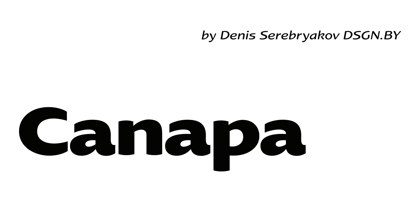
  36. Canapa by Serebryakov, $29.00
    Canapa it a simple humanistic sans serif font family. Canapa's 10 styles are good for friendly oriented package design layouts. Try!
  37. ATF Garamond by ATF Collection, $59.00
    The Garamond family tree has many branches. There are probably more different typefaces bearing the name Garamond than the name of any other type designer. Not only did the punchcutter Claude Garamond set a standard for elegance and excellence in type founding in 16th-century Paris, but a successor, Jean Jannon, some eighty years later, cut typefaces inspired by Garamond that later came to bear Garamond’s name. Revivals of both designs have been popular and various over the course of the last 100 years. When ATF Garamond was designed in 1917, it was one of the first revivals of a truly classic typeface. Based on Jannon’s types, which had been preserved in the French Imprimerie Nationale as the “caractères de l’Université,” ATF Garamond brought distinctive elegance and liveliness to text type for books and display type for advertising. It was both the inspiration and the model for many of the later “Garamond” revivals, notably Linotype’s very popular Garamond No. 3. ATF Garamond was released ca. 1918, first in Roman and Italic, drawn by Morris Fuller Benton, the head of the American Type Founders design department. In 1922, Thomas M. Cleland designed a set of swash italics and ornaments for the typeface. The Bold and Bold Italic were released in 1920 and 1923, respectively. The new digital ATF Garamond expands upon this legacy, while bringing back some of the robustness of metal type and letterpress printing that is sometimes lost in digital adaptations. The graceful, almost lacy form of some of the letters is complemented by a solid, sturdy outline that holds up in text even at small sizes. The 18 fonts comprise three optical sizes (Subhead, Text, Micro) and three weights, including a new Medium weight that did not exist in metal. ATF Garamond also includes unusual alternates and swash characters from the original metal typeface. The character of ATF Garamond is lively, reflecting the spirit of the French Renaissance as interpreted in the 1920s. Its Roman has more verve than later old-style faces like Caslon, and its Italic is outright sprightly, yet remarkably readable.
  38. Brass by HiH, $8.00
    The Brass Family has a lineage that extends into English history. About five hundred years ago a devout, but anonymous Englishman gave glory to the God he worshipped by designing the capital letters and decorations of these two fonts. Originally recorded in The History Of Mediaeval Alphabets And Devices by Henry Shaw (London 1853), they are described by Alexander Nesbitt in his Decorative Alphabets And Initials (Mineola, NY 1959) as “Initials and stop ornaments from brasses in Westminster Abbey.” I wish I could say I remember seeing them when I was there, but that was forty-two years ago and all I remember was seeing the tomb of Edward the Confessor. One definition of “stop” as a noun is a point of punctuation. I have heard people from the British Isles speak of a “full stop” when referring to a period. Some may remember a 19th century form of communication called a telegram being read aloud in an old movie, with the use of the word “stop” to indicate the end of a sentence or fragment. A full dozen of these stop ornaments are provided. They occupy positions 060, 062, 094, 123, 125, 126, 135, 137, 167, 172, 177 & 190. The Brass Family consists of two fonts: Brass and Brass Too. Both fonts have an identical upper case and ornaments, but paired with different lower cases. Although the typefaces from which the lower cases were drawn are both of modern design, both are interpretations of the textura style of blackletter in use in England when the upper case and ornaments were fashioned for the Abbey. Brass is paired with Morris Gothic, which matches the color of the upper case quite well. Brass Too is paired with Wedding Regular, which is distinctly lighter than the upper case. I find it very interesting how each connects differently. The resulting fonts are unusual and most useful for evoking an historic atmosphere.
  39. Mechanical Fun - Unknown license
  40. Middle Ages - Unknown license
Looking for more fonts? Check out our New, Sans, Script, Handwriting fonts or Categories
abstract fontscontact usprivacy policyweb font generator
Processing