8,072 search results (0.022 seconds)
  1. KR Oh Man! - Unknown license
  2. Scriptina - Unknown license
  3. PF Tempesta Five Extended - Unknown license
  4. KR Valentine Dings - Unknown license
  5. Plexifont BV - Unknown license
  6. KR Sunny Days - Unknown license
  7. Talismanica - Unknown license
  8. Quake Cyr - Unknown license
  9. SF Automaton Extended - Unknown license
  10. DS Note - Unknown license
  11. Pakenham - Unknown license
  12. SF Automaton - Unknown license
  13. SF Speakeasy Shaded - Unknown license
  14. DS CenturyCapitals - Unknown license
  15. BP Diet - 100% free
  16. SF Pale Bottom - Unknown license
  17. SF Shai Fontai - Unknown license
  18. SF Slapstick Comic - Unknown license
  19. SF Automaton Condensed - Unknown license
  20. SF Minced Meat - Unknown license
  21. Action Man Extended - Personal use only
  22. SF Chromium 24 SC - Unknown license
  23. Frant - Unknown license
  24. SF Intoxicated Blues - Unknown license
  25. SF Slapstick Comic - Unknown license
  26. SF Minced Meat - Unknown license
  27. SF Speakeasy Outline - Unknown license
  28. SF Shai Fontai - Unknown license
  29. SF Chrome Fenders - Unknown license
  30. SF Intoxicated Blues - Unknown license
  31. Riot Act 2 - Unknown license
  32. SF Square Root - Unknown license
  33. SF Burlington Script SC - Unknown license
  34. SF Proverbial Gothic - Unknown license
  35. SF Chrome Fenders - Unknown license
  36. DS FlashSerif - Unknown license
  37. SF Square Root - Unknown license
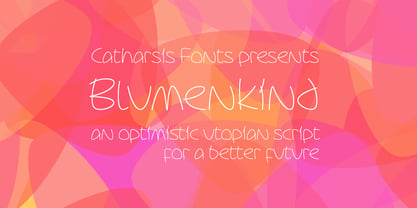
  38. Blumenkind by Catharsis Fonts, $15.00
    Blumenkind is a fresh, bright, humanist script font radiating boundless optimism and friendly enthusiasm. Its strokes are based on the rounded triangle, which lends it a dynamic bounce and a confident human touch. It shines in a wide range of display and editorial applications, but excels in particular in the context of art, creativity, food, social events, and spirituality. Blumenkind is inspired by an instance of metal-strip lettering found on the B�rgermeister Kornmesser Siedlung residential building complex in Berlin from the 1960s. The font name, being German for �flower child�, aims to capture the positive zeitgeist of that time evident in the letters. Blumenkind comes with extensive language support, tight kerning, attractive ligatures, and subtly varied alternate shapes for some of the most commonly doubled letters � and all that in three linear weights and one calligraphic weight. Furthermore, a complementary version of the font (Blumenkind Alternate) is available, in which the overlapping tittles and accent marks of the original are replaced with more traditional free-floating marks. This font is dedicated to the miracle of medical science. Thanks to Georg Seifert, Rainer Scheichelbauer, and Michael Wallner for technical aid.
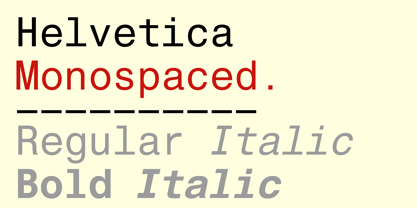
  39. Helvetica Monospaced by Linotype, $42.99
    Born in 1831, Hermann Berthold was the son of a calico-printer. On completion of his apprenticeship as a precision-instrument maker and after practical experience gained abroad in galvanography, Hermann Berthold founded his "Institute for Galvano Technology" in Berlin in 1858. Very quickly he discovered a method of producing circular lines from brass and not, as customary at that time, from lead or zinc. The soldering normally necessary could also be dispensed with. The lines were elastic and therefore highly durable. They produced outstandingly fine results. Most of German's letterpress printers and many printers abroad placed their orders with Berthold. His products became so popular that the print trade popularized the saying "As precise as Berthold brass". In 1878 Hermann Berthold was commissioned to put an end to the confusion of typographic systems of measurement. With the aid of Professor Foerster he succeeded in devising a basic unit of measurement (1m = 2,660 typographic points). This was the birth of the first generally binding system of typographic measurement. It is still used in the trade. Hermann Berthold served as the head of the Berthold type foundry until 1888.
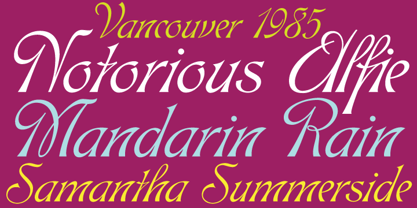
  40. Hortensia by Canada Type, $24.95
    Hortensia, designed around 1900 by Emil Gursch for his own Berlin foundry, is a typeface most expressive of the post-Victorian aesthetic that was all the rage in both Europe and America during the second half of the 19th century and up until the Great War. It is a reduced aesthetic of sharp points and natural curves that almost want to apologize for their own elegance, but clearly embody the simple excitement about the blossoming of industry and crafts during the period. This deco script trend would get a re-run for about a decade on either side of the second World War — especially in the entertainment and financial industries — before giving way to art nouveau and big brush faces. Hortensia was Gursch's most popular typeface, used extensively and prominently in many beautiful type catalogs, and a commonly seen design element in Germany for quite a while after its release. This digital version brings plenty of fixes and additions to the original metal Hortensia design, including many alternates sprinkled throughout the character set, and support for a wide range of Latin-based languages (including Central European, Baltic, Turkish and Welsh).
Looking for more fonts? Check out our New, Sans, Script, Handwriting fonts or Categories
abstract fontscontact usprivacy policyweb font generator
Processing