459 search results (0.015 seconds)
  1. Ol' 54 - Unknown license
  2. Orphiel Demo - Unknown license
  3. Santa's Hat - Personal use only
  4. sideburnBob - Unknown license
  5. Fantastic MF - Unknown license
  6. Sunburn Central - Unknown license
  7. Digitalis - Unknown license
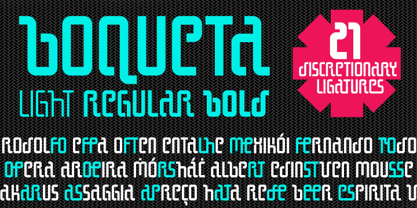
  8. Boqueta by BRtype, $18.00
    The design of Boqueta was inspired in stencil and modular forms. The project was selected for Bienal Letras Latinas 2006. The three styles include 21 discretionary ligatures.
  9. logoskate - Unknown license
  10. round - Personal use only
  11. TRASHED - Unknown license
  12. junkohanhero - Unknown license
  13. HollyWould - Unknown license
  14. Weimar - Unknown license
  15. PR Uncial Alt Caps - Unknown license
  16. Treglonou - Unknown license
  17. 2006 - Personal use only
  18. Charlie - Unknown license
  19. Carrington - Unknown license
  20. Hiccups - Unknown license
  21. HoMicIDE EFfeCt - Unknown license
  22. Scrogglet - Personal use only
  23. Lollipop - Personal use only
  24. Riky Depredador - Unknown license
  25. Mechoba - Unknown license
  26. Slim Chef - Personal use only
  27. New Land Contour - Unknown license
  28. FontForTheDumped - Unknown license
  29. Bonbon Bleu - Unknown license
  30. BOODAS.DE | Subtract - Unknown license
  31. BeachType - 100% free
  32. Teacher's Pet - Unknown license
  33. Zupagargonizer T - Unknown license
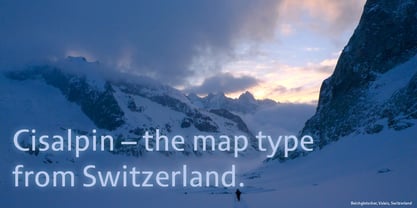
  34. Cisalpin by Linotype, $29.99
    The ideal typeface for cartography The Swiss designer/typographer Felix Arnold designed Cisalpin during the late 1990s, after he had challenged himself to create a contemporary typeface that could be used for cartographic uses. Arnold came to the subject of cartographic typefaces after analyzing many maps and atlases, and discovering that there was no standard typeface for these types of documents. Like any good cartographic type, Cisalpin is very legible at small sizes. While he was drawing this typeface on his computer, Arnold used a reduction glass to refine his design, making it work in these situations. Cisalpin is a linear sans serif face, with slight resemblance to renaissance serif types. The various weights are all clearly differentiated from one another. And because space is often a premium on maps, Cisalpin runs narrow. Words close in around themselves to help them become more identifiable. The letterforms in Cisalpin are durable, and can maintain their readability when placed over complex backgrounds. They have open interior forms, flattened curves, tall x-heights, and a capital height that almost reaches the tops of the ascenders. Cisalpin also has pronounced Italics, with a very clear angle of inclination. Each letterform in the family has been optimized so that they cannot be easily mistaken for another. This again helps minimize the misunderstandings that often occur because of illegibility. Although Cisalpin was developed for use in cartography, it may be used for countless other purposes; any font that can work well in small sizes on a map could be used almost anywhere else!
  35. Aquarius by Red Rooster Collection, $45.00
    Based on the popular VGC typeface designed by Ronald Arnholm in 1972.
  36. laundromat 1967 - Unknown license
  37. Toppo Giggio - Personal use only
  38. Marvelouz DSG - Unknown license
  39. Hangbord DSG - Unknown license
Looking for more fonts? Check out our New, Sans, Script, Handwriting fonts or Categories
abstract fontscontact usprivacy policyweb font generator
Processing